Switzerland
Zurich
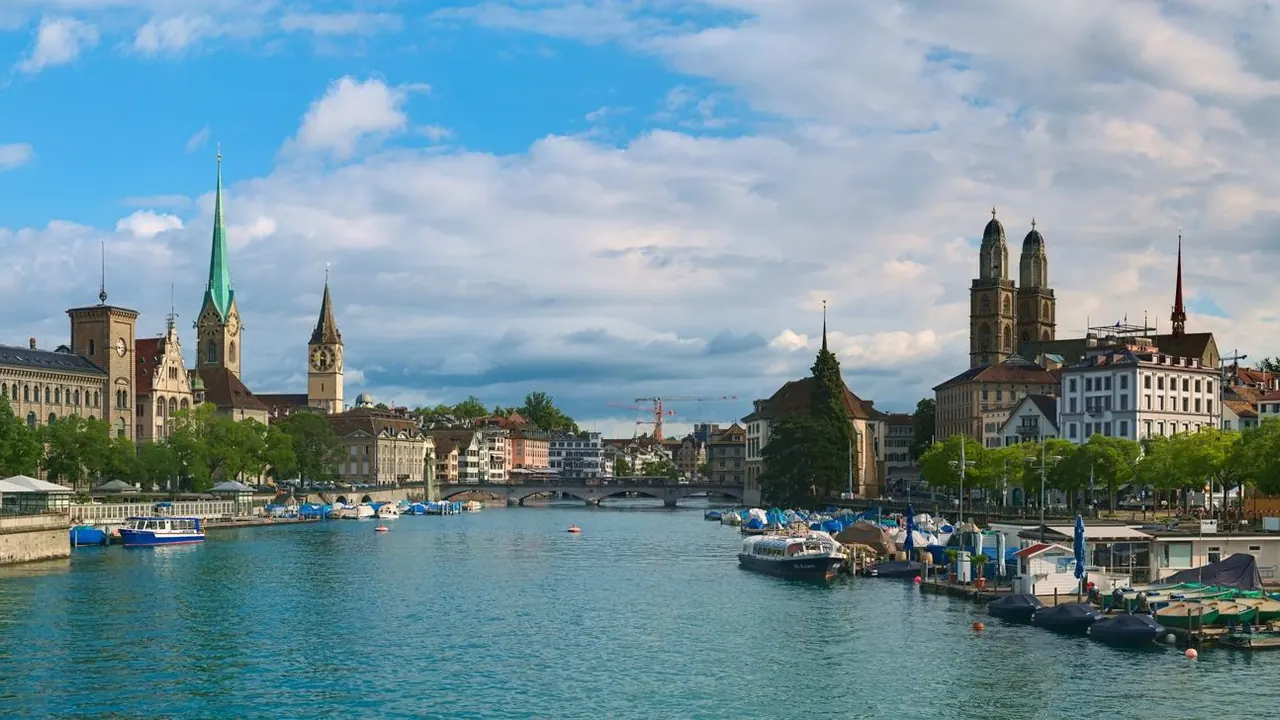
The Limmat from Quaibrücke
- Getting around95
- Day trips84
- Nature & outdoors80
Photo: Daniel Kraft, CC BY-SA 3.0, cropped
Match
63
Every category weighted equally
- Beach & sun57
- Culture & arts65
- Food & nightlife62
- Family trip62
- Outdoors64
- Relax & unwind60
- Shopping & style64
- On a budget56
Zurich in twelve categories
Our verdict on each, scored 0 to 100 against the same fixed benchmark cities, so a score means the same thing on every page.
Beaches & swimming. Scores 45 out of 100.
Food & drink. Scores 53 out of 100.
Culture & sights. Scores 58 out of 100.
Nightlife. Scores 62 out of 100.
Nature & outdoors. Scores 80 out of 100.
Day trips. Scores 84 out of 100.
Good for families. Scores 76 out of 100.
Getting around. Scores 95 out of 100.
Shopping & style. Scores 66 out of 100.
Affordability. Scores 3 out of 100.
Live music & performing arts. Scores 70 out of 100.
Wellness & relaxation. Scores 58 out of 100.
Zurich category by category
Beaches & swimming
45Zurich has no sea, but in summer it swims more than most coastal cities. Wooden bathing houses and lawned lidos line the lake shore at Utoquai, Enge, Mythenquai and Tiefenbrunnen, and the lake is clean and clear, reaching about 22°C to 24°C in July and August. On the Limmat, the river baths at Oberer and Unterer Letten draw a young crowd who let the current carry them downstream. The historic women's and men's baths sit right in the old town.
The season is short, roughly June to early September, and you swim from grass, piers and concrete decks, not sand. For a city break with a dip after sightseeing it works well. For a beach vacation, it does not.
Food & drink
53Eating in Zurich is polished and dependable rather than exciting. The local classic is Zürcher Geschnetzeltes, veal in a cream sauce served with rösti, and guild-house dining rooms and old wood-panelled taverns in the Altstadt keep fondue and raclette going in winter. Chocolate and confectionery are where the city really stands out, and the old tea rooms on Paradeplatz, famous for their Luxemburgerli, have been an institution for generations.
Kreis 4 and 5, around Langstrasse and the old industrial quarter, are home to the more casual and international places, alongside a respectable fine-dining tier. Swiss wine from the lake shore turns up on most lists. What the city lacks is street food and markets on any scale, and eating out costs a lot at every level.
Culture & sights
58Zurich's sights are good rather than famous. The Kunsthaus holds one of the strongest art collections in Switzerland, from Swiss painters through Monet, Munch and Giacometti, and the Swiss National Museum fills a castle-like building beside the main station with the country's history. The Museum Rietberg, set in a lakeside park villa, shows art from Asia, Africa and the Americas.
The Altstadt on both banks of the Limmat is compact and well kept: the twin towers of the Grossmünster, where the Reformation began in Switzerland, the Fraumünster with its Chagall stained-glass windows, the guild houses along the river and the Lindenhof terrace. Two or three days covers the essentials comfortably.
Nightlife
62Zurich goes out harder than its banking image suggests. Electronic music runs deep here. Clubs in Kreis 4 and 5 and the converted industrial spaces of Zurich West run until morning at weekends, and every August the Street Parade fills the lake shore with one of Europe's largest techno gatherings. Langstrasse is the rough-edged centre of it, with bars, kebab counters and late crowds side by side.
In summer the night moves outdoors, to bars in the lake bathing houses and drinks along the Limmat. On weeknights the city is calm, and the very high price of a round keeps nights out shorter than they might be.
Nature & outdoors
80The lake is Zurich's landscape: on clear days the snow-capped Glarus Alps stand at the far end of it. Paths and promenades follow both shores, boats run out to the villages, and the Uetliberg, the city's own hill, is a short train ride from the centre, with forest trails and a ridge walk along the Albis.
The real Alps are within about an hour. Rigi, Pilatus and the Glarus valleys offer high-mountain hiking in summer, and ski areas such as Flumserberg are close enough for a day on the slopes in winter. Cycling routes trace the lake and the Limmat valley. Expect grey, overcast spells in late autumn and winter, when fog often sits over the lake while the peaks are in sunshine.
Day trips
84Zurich sits at the centre of Switzerland's rail network, and much of the country is a comfortable day out. Lucerne, with its covered wooden bridges and lakefront, is under an hour away. Bern's arcaded UNESCO-listed old town and Basel's museums on the Rhine are about an hour each, and St Gallen's abbey library, another UNESCO site, is about the same.
North of the city, the Rhine Falls near Schaffhausen pair well with the painted medieval houses of Stein am Rhein, and Konstanz on Lake Constance is close by. Nearer still are the rose town of Rapperswil, by boat up the lake, the old spa town of Baden and the great Baroque abbey of Einsiedeln. Train connections make all of these easy without a car.
Good for families
76Zurich is an easy city with children: clean, safe, orderly, and public transport that copes with buggies. The zoo is the highlight, with a huge indoor Madagascar rainforest hall and an elephant park, and the hill it stands on has forest playgrounds. In summer the lake lidos, with shallow areas and lawns, are made for family afternoons, and boat trips on the lake suit all ages.
The Technorama science centre in Winterthur is about twenty minutes by train, and Lucerne's Swiss Museum of Transport is an easy day out. There is no big theme park nearby, and the steady pace and quiet evenings suit families with younger children best.
Getting around
95Getting around Zurich is almost effortless. The old town and lake shore are compact enough to walk, and the blue trams reach every neighbourhood, with buses, S-Bahn trains, the Uetliberg railway, funiculars and even the lake boats all on the same integrated ticket. Services are punctual and stops are clearly signed.
The airport is a short train ride from the main station, which also connects straight to the rest of the country. Nobody visiting needs a car, and the city's traffic calming and pricey parking make one more trouble than it is worth.
Shopping & style
66Bahnhofstrasse is one of the world's great luxury streets, running from the main station to the lake past watchmakers, jewellers, fashion houses and long-established department stores. Watches are the speciality, from the big Swiss names to small dealers in the side streets, and Swiss chocolate is the souvenir everyone takes home.
The Niederdorf and the lanes of the Altstadt hold smaller boutiques and antique shops. In Zurich West, the arches of the old railway viaduct have been turned into design shops and a covered food market. Flea markets run on summer Saturdays. Beyond luxury and design, though, the range is narrow, and everything costs a lot.
Affordability
3Zurich is one of the most expensive cities in the world to visit. Hotel rooms, even simple ones, cost far more than in most European capitals, a casual lunch costs what a good dinner does elsewhere, and drinks are steep. Transport and museums are also priced high, though the integrated travel pass and a visitor card that bundles transport with museum entry soften the blow a little.
Travellers on a budget save by buying lunch at supermarkets, picnicking by the lake and using the free public lidos and drinking fountains. Even so, nobody comes here to make their money go further.
Live music & performing arts
70For a city of its size, Zurich takes its stage seriously. The Opernhaus on the lake shore is one of Europe's most respected opera houses, with a full season of opera and ballet, and the Tonhalle Orchestra plays in a richly restored nineteenth-century concert hall. The Schauspielhaus is one of the leading theatres of the German-speaking world, though most of its work is in German.
On the alternative side, the old Rote Fabrik factory by the lake and venues around Kreis 4 and 5 host jazz, indie and electronic acts, and touring bands come through often. In summer, open-air film and festivals like the Theater Spektakel bring performance to the lake shore.
Wellness & relaxation
58Zurich is a quiet, orderly city that makes it easy to slow down. Its best-known bath fills the stone vaults of the old Hürlimann brewery, with thermal pools, a Roman-Irish bathing circuit and a rooftop pool looking over the city. In the colder months, the historic wooden bathing houses on the lake and the Limmat open as saunas, with dips in the cold water between sessions.
The town of Baden, about twenty minutes by train, has been built around hot springs since Roman times and makes an easy half-day soak. Beyond that, wellness means hotel spas and the calm of the lake shore, not a deep bathing tradition.
When should you go?
Pick a month to see what it is like. The climate figures are measured averages, not a forecast.
Zurich in July
Daytime high, °C
Rainfall in the month, mm
The whole year
Shaded against this city’s own year: the deepest cell is its best month for that figure and the palest its weakest.
Temperature and rainfall are climate normals, averaged over the years shown. Zurich: 1991-2020 normals, Zurich Town / Ville. (2.2 km from centre).
Before you go
| Measure | Zurich |
|---|---|
| Official language | French, German, Italian, Romansh |
| Currency | Swiss Franc (CHF) |
| Sockets | CJ230 V, 50 Hz |
| Driving side | Right |
| Time zone | UTC+1, UTC+2 in summer |
| Emergency number | 112 |
| Elevation | 408 m |
| Main airport | Zürich Airport (ZRH)9 km from centre226 non-stop destinations |
| Public holidays this year | 10 days |
By the numbers
| Measure | Zurich |
|---|---|
| City population | 440,935 |
| People per km² | 5,016 |
| Museums within 10 km | 63 |
| UNESCO World Heritage sites within 50 km | 1 |
Compare Zurich with
Every comparison with a written verdict behind it.
- Amsterdam
- Annecy
- Antibes
- Avignon
- Baden-Baden
- Bled
- Bologna
- Brussels
- Cannes
- Cologne
- Como
- Florence
- Frankfurt
- Geneva
- Genoa
- Heidelberg
- Innsbruck
- Interlaken
- La Spezia
- Ljubljana
- Lucerne
- Lyon
- Maastricht
- Milan
- Monaco
- Munich
- Nice
- Nuremberg
- Paris
- Pisa
- Portofino
- Rovinj
- Saint-Tropez
- Salzburg
- Strasbourg
- Stuttgart
- Turin
- Venice
- Verona