Italy
Matera
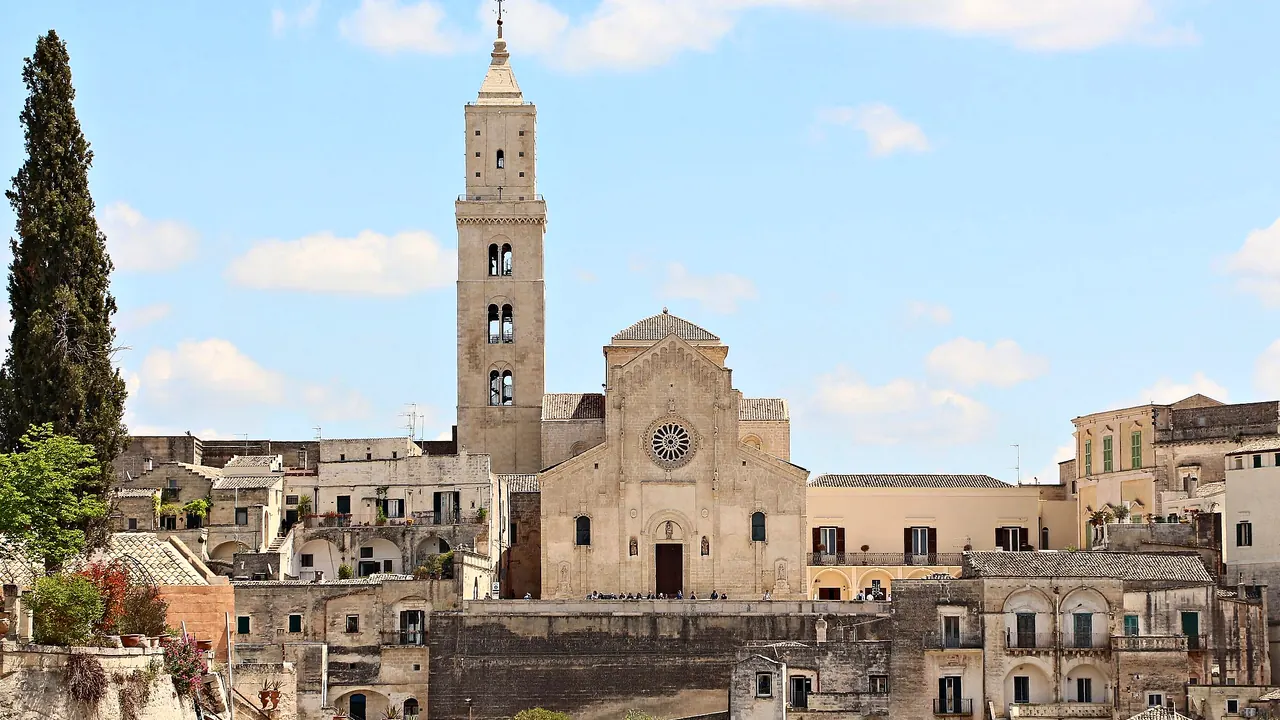
The cathedral and its bell tower above the Sassi
- Day trips78
- Culture & sights70
- Nature & outdoors62
Photo: Bernard Gagnon, CC BY 4.0, cropped
Match
44
Every category weighted equally
- Beach & sun44
- Culture & arts47
- Food & nightlife40
- Family trip47
- Outdoors52
- Relax & unwind46
- Shopping & style41
- On a budget45
Matera in twelve categories
Our verdict on each, scored 0 to 100 against the same fixed benchmark cities, so a score means the same thing on every page.
Beaches & swimming. Scores 40 out of 100.
Food & drink. Scores 50 out of 100.
Culture & sights. Scores 70 out of 100.
Nightlife. Scores 20 out of 100.
Nature & outdoors. Scores 62 out of 100.
Day trips. Scores 78 out of 100.
Good for families. Scores 30 out of 100.
Getting around. Scores 45 out of 100.
Shopping & style. Scores 25 out of 100.
Affordability. Scores 55 out of 100.
Live music & performing arts. Scores 18 out of 100.
Wellness & relaxation. Scores 35 out of 100.
Matera category by category
Beaches & swimming
40Matera sits inland on a limestone plateau, so the beach is a day out, not part of daily life. The nearest shore is the Ionian coast around Metaponto and Policoro, about 45 minutes by car. There you find long, wide sandy beaches backed by pine woods and calm, shallow water that reaches about 25°C in August, which makes them easy for children. The Adriatic towns of Puglia, with rocky coves and clearer water, are well over an hour away. Without a car the sea is hard to reach, and most visitors to Matera never swim at all.
Food & drink
50Food in Matera is the peasant cooking of Basilicata, plain and confident. The base is pane di Matera, a durum-wheat loaf with a thick crust and a horn-like shape. Around it come fave e cicoria, crapiata (a soup of mixed pulses), hand-made cavatelli and orecchiette, roast lamb, and peperoni cruschi, sweet dried peppers fried until they crackle. Caciocavallo and pecorino come from the surrounding hills, and the strong red to drink is Aglianico del Vulture.
Many of the restaurants are in cave rooms in the Sassi. The better cooking and fairer prices are often in the upper town around Via Ridola and Piazza Vittorio Veneto. It is a small city, so there is little range beyond regional cooking, and no real street food or market culture.
Culture & sights
70The Sassi are the reason to come. Two ravine-side districts, Sasso Caveoso and Sasso Barisano, are made of cave dwellings, carved churches and stacked houses that climb the side of the Gravina gorge. People have lived in them since prehistoric times. Between them, on the Civita hill, stands the Romanesque cathedral. Rock churches such as Santa Maria de Idris, San Pietro Barisano and Santa Lucia alle Malve keep faded Byzantine and medieval frescoes, and furnished cave houses show how families lived alongside their animals until the 1950s.
In the upper town, the Palombaro Lungo is a huge water cistern under the main piazza that you can walk through. The Museo Ridola holds regional archaeology, Palazzo Lanfranchi has Carlo Levi's large panorama of Lucanian life, and MUSMA displays sculpture in carved rock rooms. The set is small but like nowhere else, and it is at its best at dusk, when the lights come on across the Sassi.
Nightlife
20Evenings in Matera revolve around the passeggiata along Via del Corso and Piazza Vittorio Veneto, a long dinner, and a glass of wine on a terrace above the lit-up Sassi. A handful of wine bars and cocktail bars in cave rooms stay open late in summer, and there is a small student crowd. There are no real clubs, and outside the warm months the town is quiet soon after dinner. It suits couples who want a beautiful setting for a drink, not anyone who wants a night out.
Nature & outdoors
62The Gravina gorge sits right below the Sassi. On the far side is the Parco della Murgia Materana, a stony upland of wild thyme, grazing land and caves. From the bottom of Sasso Caveoso a path drops to the stream and climbs up to the Belvedere at Murgia Timone, where trails lead past abandoned rock churches and Neolithic village sites, with the best view of the town. Kestrels nest in the cliffs.
Further out, the jagged sandstone peaks of the Lucanian Dolomites are about an hour and a quarter by car, and the beech and pine forests of the Pollino national park are a longer day. Spring and autumn are the seasons for walking. In July and August the bare plateau is very hot, so set out early.
Day trips
78Matera sits on the border with Puglia, which makes it a good base for exploring. Altamura, famous for its bread and cathedral, is twenty minutes away, and Gravina in Puglia, with its bridge over its own ravine, is not much further. Within about an hour you reach the trulli of Alberobello, the white towns of the Valle d'Itria such as Locorotondo, Martina Franca and Ostuni, and the old town of Bari. Castel del Monte, the octagonal castle of Frederick II, and Polignano a Mare on its sea cliffs are about the same distance away.
In Basilicata itself, the abandoned hill town of Craco, the Greek temple of Hera at Metaponto, and the villages of Castelmezzano and Pietrapertosa among the peaks all make strong outings. For almost all of them you need a car.
Good for families
30Children are welcome everywhere in Matera, and older ones usually enjoy the caves, the underground cistern and scrambling down into the gorge. But nothing in the town is made for children. The Sassi are a maze of steep, uneven stone steps where a pushchair is useless, and summer afternoons are hot with little shade. Families do best with a short stay, a baby carrier, and a car for trips to the sandy Ionian beaches or the trulli of Alberobello.
Getting around
45Within Matera everything is on foot. The upper town is flat and easy, and the Sassi are a short walk below, though you reach them by steep stairways and lanes that wear out the legs. Cars cannot enter most of the old districts. Getting further is harder. Matera is off the national rail network, a slow narrow-gauge line runs to Bari in about an hour and a half, and buses are sparse. Most day trips, the beaches and the parks are far easier with a hire car.
Shopping & style
25Shopping in Matera is small-scale and mostly aimed at visitors. Workshops and stalls in the Sassi sell the cuccù, a painted terracotta whistle shaped like a cockerel, alongside miniature carvings of the town in local tufa stone, papier-mâché, and ceramics. The upper town has ordinary Italian high-street shops along Via del Corso. Food is the best thing to take home: dried peppers, local pasta and bottles of Aglianico.
Affordability
55Eating and drinking in Matera cost noticeably less than in the big Italian cities, especially in the simple trattorias of the upper town. The Sassi themselves are pricier. Cave hotels and boutique stays there are the town's speciality and are priced accordingly, and the busiest summer weeks push up rates. Guesthouses in the newer town are much cheaper and only a short walk from the old districts. Most sights cost little, and walking the Sassi and the Murgia is free.
Live music & performing arts
18Matera has little regular live performance. The music conservatory puts on concerts, and summer brings open-air events and a jazz festival, some of them staged against the backdrop of the Sassi. The Festa della Bruna, the town's patron feast with its procession and the ritual tearing apart of a papier-mâché float, is the big night of the year. Otherwise evenings are for dinner and the view.
Wellness & relaxation
35There are no thermal baths or bathing traditions in Matera. The wellness on offer is in hotel spas, some of them set in candlelit cave rooms with pools cut into the rock, which is an unusual way to unwind. The town's real calm comes from its pace: quiet mornings in the Sassi before the tour groups arrive, long lunches, and evenings watching the light fade over the gorge. The quieter months, from autumn to spring, are the most restful.
When should you go?
Pick a month to see what it is like. The climate figures are measured averages, not a forecast.
Matera in July
Daytime high, °C
Rainfall in the month, mm
The whole year
Shaded against this city’s own year: the deepest cell is its best month for that figure and the palest its weakest.
Where the figures come from
Matera has no rain gauge within 25 km of the centre, so its rainfall comes from a gridded climate dataset read at the city rather than from a gauge further away.
Temperature and rainfall are climate normals, averaged over the years shown. Matera: 2005-2025, 10 years observed (rainfall 1991-2020) normals, Matera / Martella (4.8 km from centre).
Before you go
| Measure | Matera |
|---|---|
| Official language | Italian |
| Currency | Euro (EUR) |
| Sockets | CFL230 V, 50 Hz |
| Driving side | Right |
| Time zone | UTC+1, UTC+2 in summer |
| Emergency number | 112 |
| Elevation | 401 m |
| Main airport | Bari Karol Wojtyła International Airport (BRI)54 km from centre104 non-stop destinations |
| Public holidays this year | 13 days |
By the numbers
| Measure | Matera |
|---|---|
| City population | 59,685 |
| People per km² | 152 |
| Museums within 10 km | 8 |
| UNESCO World Heritage sites within 50 km | 1 |
| Swim season, months above 21 °C | 5 months |
Compare Matera with
Every comparison with a written verdict behind it.
- Amalfi
- Bari
- Bologna
- Catania
- Como
- Cortina d'Ampezzo
- Dubrovnik
- Florence
- Genoa
- Granada
- Kotor
- La Spezia
- Lecce
- Lucca
- Milan
- Mostar
- Naples
- Palermo
- Pisa
- Portofino
- Positano
- Rome
- Salerno
- Sarajevo
- Siena
- Skopje
- Sorrento
- Split
- Tirana
- Trieste
- Turin
- Venice
- Verona
- Zadar