Germany
Rothenburg ob der Tauber
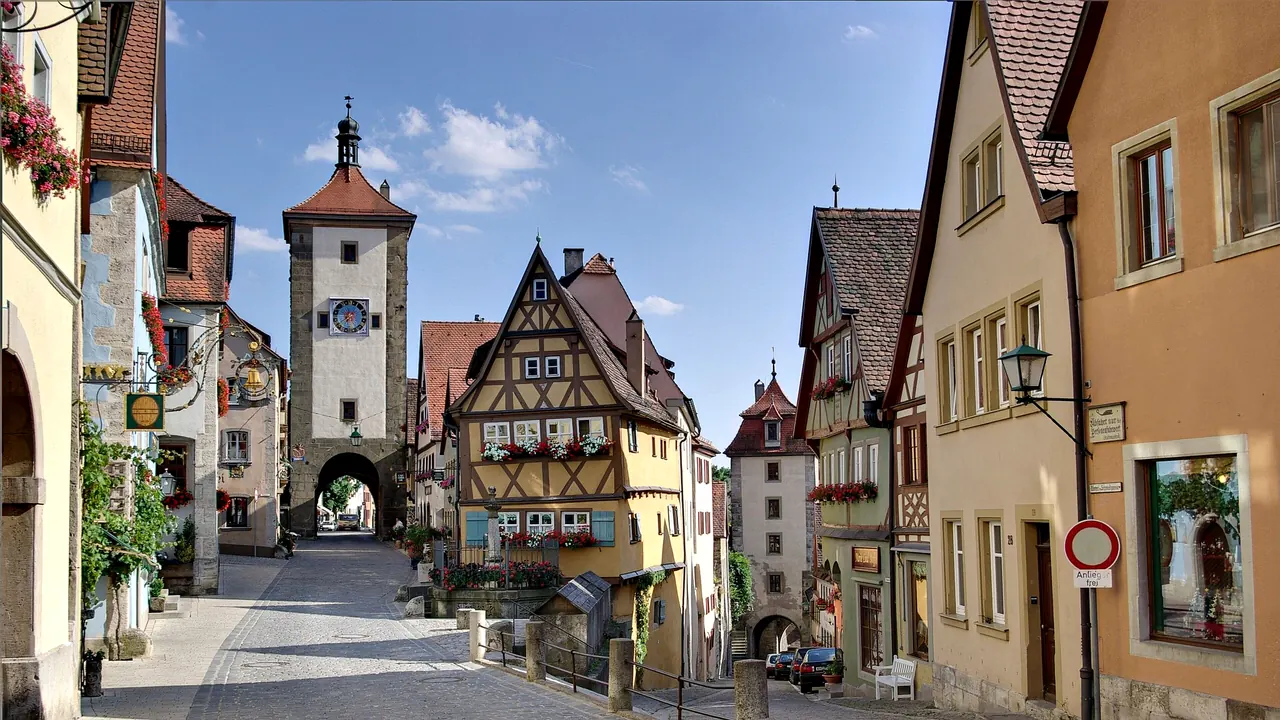
The Plönlein and the Siebers Tower
- Day trips70
- Culture & sights62
- Getting around60
Photo: Berthold Werner, Public domain
Match
37
Every category weighted equally
- Beach & sun34
- Culture & arts42
- Food & nightlife33
- Family trip41
- Outdoors42
- Relax & unwind37
- Shopping & style37
- On a budget38
Rothenburg ob der Tauber in twelve categories
Our verdict on each, scored 0 to 100 against the same fixed benchmark cities, so a score means the same thing on every page.
Beaches & swimming. Scores 7 out of 100.
Food & drink. Scores 30 out of 100.
Culture & sights. Scores 62 out of 100.
Nightlife. Scores 8 out of 100.
Nature & outdoors. Scores 38 out of 100.
Day trips. Scores 70 out of 100.
Good for families. Scores 42 out of 100.
Getting around. Scores 60 out of 100.
Shopping & style. Scores 28 out of 100.
Affordability. Scores 45 out of 100.
Live music & performing arts. Scores 18 out of 100.
Wellness & relaxation. Scores 40 out of 100.
Rothenburg ob der Tauber category by category
Beaches & swimming
7Rothenburg is a hilltop town in the middle of Franconia, hundreds of kilometres from any coast. In summer, swimming means the town's outdoor pool or a drive of about an hour to the Franconian lake district, where artificial lakes such as the Altmühlsee have grassy bathing areas. Nobody comes here for the water.
Food & drink
30Eating here means hearty Franconian cooking in timbered inns: roast pork with dumplings, Schäufele, bratwurst and sauerkraut, with dry Franconian Silvaner from the dumpy Bocksbeutel bottle or a beer from a regional brewery. The local speciality is the Schneeball, a ball of fried pastry strips dusted with sugar or dipped in chocolate. It is sold all over the old town and looks better than it tastes.
The range is narrow and many places around the Marktplatz cook for the coach parties. The better meals tend to be in family-run guesthouses away from the main square and in wine taverns serving the Tauber valley's own wines. Fine dining and international food are scarce.
Culture & sights
62Rothenburg's draw is the town itself: one of the most complete medieval walled towns in Europe, with gabled houses, cobbled lanes and towers, and almost nothing modern inside the walls. A covered walkway runs along much of the wall and looks out over the rooftops. The Plönlein, a small fork of lanes between two gate towers, is the classic view, and the Rathaus tower above the Marktplatz gives the wider one.
St Jakob's church holds Tilman Riemenschneider's carved Holy Blood Altar, a masterpiece of late Gothic woodcarving. The Medieval Crime Museum is the town's most substantial museum, covering law and punishment over centuries. The Burggarten and the Tauber valley below finish a visit that is rewarding but short.
Nightlife
8Evenings in Rothenburg are quiet. Once the day visitors leave, the old town settles into wine taverns and inn dining rooms, and the most popular evening outing is the night watchman's walking tour. There are no clubs to speak of and the lanes are mostly silent by eleven. If you want a proper night out, Würzburg or Nuremberg are the nearest options.
Nature & outdoors
38The town stands on a spur above the Tauber, and paths drop straight from the walls into a green valley with mills, meadows and the little Topplerschlösschen tower house. The Tauber valley cycle path, one of Germany's best-known family cycling routes, follows the river downstream through vineyards and villages. The rolling Frankenhöhe nature park lies to the south and east.
The outdoors here is pleasant and gentle rather than dramatic: easy valley walks, quiet farm roads and orchards that look best in spring blossom and autumn colour. There are no mountains, large lakes or wild country nearby.
Day trips
70Rothenburg sits on the Romantic Road, and nearby are several towns that rival it. Dinkelsbühl, another walled medieval town, is about 45 minutes south by car, and Nördlingen, a complete circle of walls inside a meteorite crater, is a little further. Schwäbisch Hall's steep half-timbered centre and the Renaissance palace and gardens at Weikersheim are both about an hour away.
Würzburg, with its UNESCO-listed Residenz and vineyards on the Main, is about an hour by car, and Nuremberg's castle and old town are about the same. Bamberg is at the edge of two hours. The train needs a change on a quiet branch line, so a car makes the region far easier.
Good for families
42For children the town works like a storybook castle: they can walk the covered ramparts, climb the Rathaus tower, and follow the night watchman with his lantern and halberd. Older children are often gripped by the torture devices and shame masks in the Medieval Crime Museum. The walled centre is small, safe and mostly free of through traffic.
There is little made for children beyond that. A day or two covers it, the cobbles are hard on pushchairs, and the steep valley paths are hard work for small legs. Families usually pair a stay with excursions or a swimming pool day.
Getting around
60Inside the walls everything is on foot: you can cross the old town in fifteen minutes, and the main sights sit within a few lanes of the Marktplatz. The lanes are cobbled and the climb back up from the Tauber valley is steep. Cars are kept to the edges, with parking outside the gates, so the centre is pleasant to walk.
Beyond the walls it gets harder. The station is a short walk from the gates, but Rothenburg is at the end of a short branch line, and most rail journeys mean a change at Steinach for Würzburg, Ansbach or Nuremberg. Regional buses to the villages and other Romantic Road towns are sparse, especially at weekends, so a car is the practical way to explore the area.
Shopping & style
28Shopping in Rothenburg is all about Christmas. Several year-round shops sell glass baubles, wooden nutcrackers, smoking men and Erzgebirge carvings, and some visitors come mainly for these. Add teddy bears, cuckoo clocks, pewter, Franconian wine and Schneeballen, and that is most of what the Herrngasse and Schmiedgasse sell.
The Christmas market on the Marktplatz is one of the most atmospheric in Germany. Fashion, design and everyday shopping are almost absent, and much of what is for sale is aimed squarely at visitors.
Affordability
45Prices are typical of small-town Germany with a tourist premium on top. Rooms in the old guesthouses inside the walls and meals around the Marktplatz cost more than in ordinary Franconian towns, and both peak in December and on summer weekends. Beer and wine in local inns are reasonably priced, the sights charge modest entry fees, and walking is free. Staying just outside the walls or in a nearby village saves a good deal.
Live music & performing arts
18Performance here mostly means history plays. The Meistertrunk festival play, re-enacting the legendary wine-drinking feat that saved the town in the Thirty Years' War, is staged every year in costume, alongside processions and encampments. A small open-air theatre runs summer productions, and St Jakob's church holds organ and choral concerts. Outside these moments there is no regular theatre, concert or live-music life, so evenings are spent at dinner rather than at a show.
Wellness & relaxation
40Rothenburg slows down noticeably in the early morning and after the coach groups leave in the evening. Then the lanes empty and a walk on the walls or down into the Tauber valley is deeply quiet. Some of the larger hotels have small spas, but the town has no bathing tradition of its own.
For proper thermal bathing, drive to Bad Windsheim, whose Franken-Therme has a salt-water pool you float in, or to the older spa town of Bad Mergentheim. Both are within about an hour.
When should you go?
Pick a month to see what it is like. The climate figures are measured averages, not a forecast.
Rothenburg ob der Tauber in July
Daytime high, °C
Rainfall in the month, mm
The whole year
Shaded against this city’s own year: the deepest cell is its best month for that figure and the palest its weakest.
Where the figures come from
Rothenburg ob der Tauber's sunshine is measured 27 km from the centre, at Feuchtwangen-heilbronn.
Temperature and rainfall are climate normals, averaged over the years shown. Rothenburg ob der Tauber: 1991-2020 normals, Rothenburg ob der Tauber (0.9 km from centre).
Before you go
| Measure | Rothenburg ob der Tauber |
|---|---|
| Official language | German |
| Currency | Euro (EUR) |
| Sockets | CF230 V, 50 Hz |
| Driving side | Right |
| Time zone | UTC+1, UTC+2 in summer |
| Emergency number | 112 |
| Elevation | 430 m |
| Main airport | Nuremberg Airport (NUE)66 km from centre56 non-stop destinations |
| Public holidays this year | 12 days |
By the numbers
| Measure | Rothenburg ob der Tauber |
|---|---|
| City population | 11,331 |
| People per km² | 272 |
| Museums within 10 km | 6 |
| UNESCO World Heritage sites within 50 km | 2 |
Compare Rothenburg ob der Tauber with
Every comparison with a written verdict behind it.
- Amsterdam
- Annecy
- Antwerp
- Baden-Baden
- Bamberg
- Basel
- Bergamo
- Berlin
- Bern
- Bled
- Brno
- Brussels
- Cesky Krumlov
- Chamonix
- Colmar
- Cologne
- Como
- Cortina d'Ampezzo
- Dijon
- Dresden
- Dusseldorf
- Frankfurt
- Freiburg
- Geneva
- Ghent
- Graz
- Hallstatt
- Hamburg
- Heidelberg
- Innsbruck
- Interlaken
- Karlovy Vary
- Lausanne
- Leipzig
- Ljubljana
- Lubeck
- Lucerne
- Lugano
- Luxembourg
- Maastricht
- Milan
- Munich
- Nuremberg
- Padua
- Piran
- Prague
- Rotterdam
- Salzburg
- Strasbourg
- Stuttgart
- Trieste
- Utrecht
- Venice
- Verona
- Vienna
- Zermatt
- Zurich