Italy
Rome
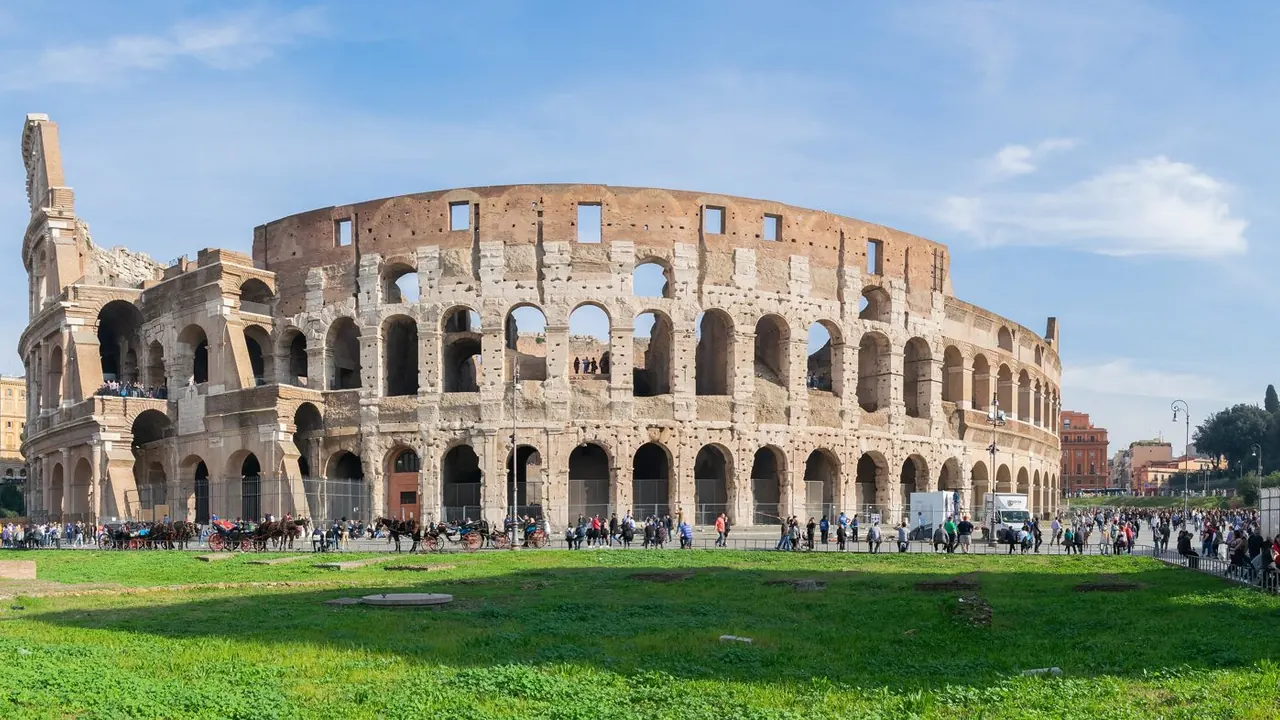
The Colosseum
- Culture & sights99
- Day trips92
- Food & drink82
Photo: Tournasol7, CC BY-SA 4.0, cropped
Match
64
Every category weighted equally
- Beach & sun59
- Culture & arts71
- Food & nightlife67
- Family trip61
- Outdoors64
- Relax & unwind61
- Shopping & style67
- On a budget61
Rome in twelve categories
Our verdict on each, scored 0 to 100 against the same fixed benchmark cities, so a score means the same thing on every page.
Beaches & swimming. Scores 50 out of 100.
Food & drink. Scores 82 out of 100.
Culture & sights. Scores 99 out of 100.
Nightlife. Scores 58 out of 100.
Nature & outdoors. Scores 58 out of 100.
Day trips. Scores 92 out of 100.
Good for families. Scores 50 out of 100.
Getting around. Scores 60 out of 100.
Shopping & style. Scores 72 out of 100.
Affordability. Scores 38 out of 100.
Live music & performing arts. Scores 68 out of 100.
Wellness & relaxation. Scores 40 out of 100.
Rome category by category
Beaches & swimming
50Rome is not a beach city, but the sea is closer than most visitors expect. Ostia, reached by suburban train in about half an hour, has long stretches of dark volcanic sand, mostly divided into paid lidos with rows of umbrellas, and a strip of free beach further south towards Castel Porziano. Fregene, to the north, is a little more relaxed. In July and August the water reaches about 25°C and is pleasant for swimming, though it is rarely clear.
Romans treat these beaches as a weekend escape from the heat, and they fill up accordingly. For clean water and prettier coves you need a longer trip south to Sperlonga or Sabaudia, which makes the sea a day out rather than part of the stay.
Food & drink
82Rome has a cuisine entirely its own, and it is best eaten in plain trattorias rather than grand restaurants. The four classic pastas, carbonara, cacio e pepe, amatriciana and gricia, are the backbone, alongside artichokes fried the Jewish way in the old Ghetto, saltimbocca and the offal dishes of Testaccio's old slaughterhouse quarter. Street food is serious: pizza al taglio sold by weight, fried supplì, and thin, crisp Roman pizza in the evening.
Days run on standing espresso at the bar counter and gelato from artisan makers. Testaccio's covered market and the neighbourhood markets are better for eating than tourist-heavy Campo de' Fiori. The main weakness is the centre, where menus in five languages near the big sights mean dull food, so walk to Trastevere, Monti or Testaccio. Local wine is modest, though Frascati comes from the nearby hills.
Culture & sights
99No city holds more history in one place. Ancient Rome is still standing in the middle of town: the Colosseum, the Roman Forum and the Palatine, the Pantheon with its open dome, Trajan's Markets and the Baths of Caracalla. Layered on top are early Christian basilicas with gold mosaics, Renaissance palaces and the Baroque city of Bernini and Borromini, with its piazzas, fountains and churches where Caravaggios hang above side altars.
The museums alone justify a trip: the Vatican Museums and the Sistine Chapel, St Peter's, the Borghese Gallery, the Capitoline Museums and the ancient sculpture of Palazzo Massimo. Even an aimless walk passes obelisks, aqueduct arches and medieval towers. A week barely scratches it, and the hardest part of planning is deciding what to leave out.
Nightlife
58Evenings in Rome start with aperitivo and spill out into the piazzas, where much of the night happens outdoors with a drink in hand. Trastevere is the most popular area, its lanes crowded with wine bars and young Romans and visitors until late. Monti has smaller cocktail and wine bars, San Lorenzo is the cheap student quarter, and Pigneto has a more alternative, arty crowd.
Clubbing is a smaller part of the picture, concentrated around Testaccio and Ostiense, and the scene lacks the depth or reputation that would draw people for it. It suits visitors who enjoy long dinners followed by a late stroll and a glass outside rather than dancing until dawn.
Nature & outdoors
58Inside the city, the green comes from the old aristocratic villa parks, Villa Borghese, Villa Pamphili and Villa Ada, and from the Appian Way park, where a cobbled Roman road runs out through fields, tombs and aqueduct ruins and makes one of the finest bike rides of any capital. The Tiber has a riverside path, though the river itself is little used.
Beyond the ring road the Alban Hills rise to the southeast, with the crater lakes of Albano and Nemi among chestnut woods. The Apennines, with hiking in the Simbruini mountains and winter skiing at Terminillo, are roughly ninety minutes away, and the wilder Abruzzo peaks a little further. Summer heat makes midday outdoor activity hard, so spring and autumn are the seasons for it.
Day trips
92Rome is a superb base for day trips. Close in are Ostia Antica, a whole excavated Roman port town about half an hour away, and Tivoli, with the fountain gardens of Villa d'Este and the vast ruins of Hadrian's Villa. The Castelli Romani hill towns, Frascati among them, offer wine and porchetta with views back over the city.
North of the city lie the Etruscan painted tombs of Tarquinia and Cerveteri, medieval Viterbo, cliff-top Orvieto with its cathedral, and Civita di Bagnoregio on its eroding ridge. Assisi is about two hours away. High-speed trains also put Florence and Naples within about ninety minutes, and Pompeii can be reached in a long day.
Good for families
50Italians love children, and families are welcome in every trattoria, but Rome is not set up for a children's vacation. Its great sights are aimed at adults, and queues for the Vatican or Colosseum test young patience. Gladiators, catacombs and the Mouth of Truth help to catch their interest, as do daily gelato and pizza.
Villa Borghese has the Bioparco zoo, rowing boats and space to run, and there is a children's museum near Piazza del Popolo. Summer heat and crowds, uneven cobbles that are hard on pushchairs and busy roads make sightseeing tiring work, so spring and autumn visits with an unhurried plan work best.
Getting around
60Most of what a visitor wants is in the historic centre, and the best way to see it is on foot. The walk from the Colosseum to the Pantheon to Piazza Navona and across the river to Trastevere is short, and much of the pleasure of Rome is in the streets between sights.
Public transport is the weak point. The metro has only a few lines, and because of the archaeology underground it barely enters the core, though it serves the Vatican, the Spanish Steps, Termini and the Colosseum. Buses and trams fill the gaps but get stuck in traffic. Cobblestones, scooters and summer heat make walking hard on the feet, and a car is a burden rather than a help.
Shopping & style
72Shopping in Rome is strongest at the luxury end. The streets fanning out from the Spanish Steps, Via Condotti, Via Borgognona and Via Frattina, are lined with the big Italian fashion houses, and Via del Corso has the mainstream chains. Monti is the quarter for small independent boutiques, vintage and young designers, and the lanes around Via dei Coronari and Via Margutta keep antique dealers, framers and artisan workshops.
The Sunday flea market at Porta Portese is huge and chaotic. Leather goods, handmade shoes, paper and religious objects near the Vatican are worthwhile buys. The department-store tradition is weak, and much of what lines the main tourist routes is souvenir stock.
Affordability
38Rome is a fairly expensive city to stay in, mostly because of accommodation: rooms in the historic centre are costly and small, and they are hard to find in spring and autumn. The major sights, the Vatican Museums, the Colosseum and the Borghese Gallery, all charge substantial entry fees.
Daily costs are kinder. Espresso drunk standing at the bar, pizza al taglio and simple trattoria lunches are fair value, tap water flows free from the city's drinking fountains, and churches full of masterpieces are open to all. Staying outside the centre and eating where Romans eat keeps it manageable.
Live music & performing arts
68Rome has a solid classical scene. The Teatro dell'Opera stages opera and ballet through the winter, and in summer it moves outdoors to the ruins of the Baths of Caracalla, one of the most memorable settings for opera anywhere. The Santa Cecilia orchestra plays at the Auditorium Parco della Musica, Renzo Piano's concert complex north of the centre, which also hosts jazz, pop and world music.
Churches host frequent sacred and organ concerts, and the city has a long-running jazz club scene. Theatre is largely in Italian, so most visitors stick to music. Summer brings festivals and open-air concerts in parks and ancient sites.
Wellness & relaxation
40Although its ancient baths are some of the most famous ruins in the city, Rome has no bathing culture of its own today. Wellness in the city means hotel spas and a few hammam-style day spas. The nearest real thermal water is at Bagni di Tivoli, where the sulphurous Acque Albule springs feed a large outdoor pool complex. Further north, around Viterbo, there are hot springs, including free open-air pools, about ninety minutes away.
The centre itself is loud, with scooters, crowds and heat, though the Roman habit of a long lunch and an evening passeggiata offers some calm. The villa gardens and the Aventine hill are the quiet places to stop.
When should you go?
Pick a month to see what it is like. The climate figures are measured averages, not a forecast.
Rome in July
Daytime high, °C
Rainfall in the month, mm
The whole year
Shaded against this city’s own year: the deepest cell is its best month for that figure and the palest its weakest.
Where the figures come from
Rome's sunshine is measured 31 km from the centre, at Vigna Di Valle.
Temperature and rainfall are climate normals, averaged over the years shown. Rome: 1991-2020 normals, Roma / Ciampino (15.1 km from centre).
Before you go
| Measure | Rome |
|---|---|
| Official language | Italian |
| Currency | Euro (EUR) |
| Sockets | CFL230 V, 50 Hz |
| Driving side | Right |
| Time zone | UTC+1, UTC+2 in summer |
| Emergency number | 112 |
| Elevation | 21 m |
| Main airport | Rome–Fiumicino Leonardo da Vinci International Airport (FCO)23 km from centre242 non-stop destinations |
| Public holidays this year | 13 days |
By the numbers
| Measure | Rome |
|---|---|
| City population | 2,748,109 |
| People per km² | 2,135 |
| Museums within 10 km | 178 |
| UNESCO World Heritage sites within 50 km | 7 |
| Swim season, months above 21 °C | 5 months |
Compare Rome with
Every comparison with a written verdict behind it.
- Amalfi
- Antibes
- Athens
- Barcelona
- Bologna
- Cannes
- Catania
- Como
- Dubrovnik
- Florence
- Genoa
- La Spezia
- Ljubljana
- London
- Madrid
- Milan
- Monaco
- Mostar
- Naples
- Nice
- Palermo
- Paris
- Pisa
- Portofino
- Positano
- Rovinj
- Salerno
- Siena
- Sorrento
- Split
- Turin
- Venice
- Verona
- Xi'an
- Zadar