Austria
Salzburg
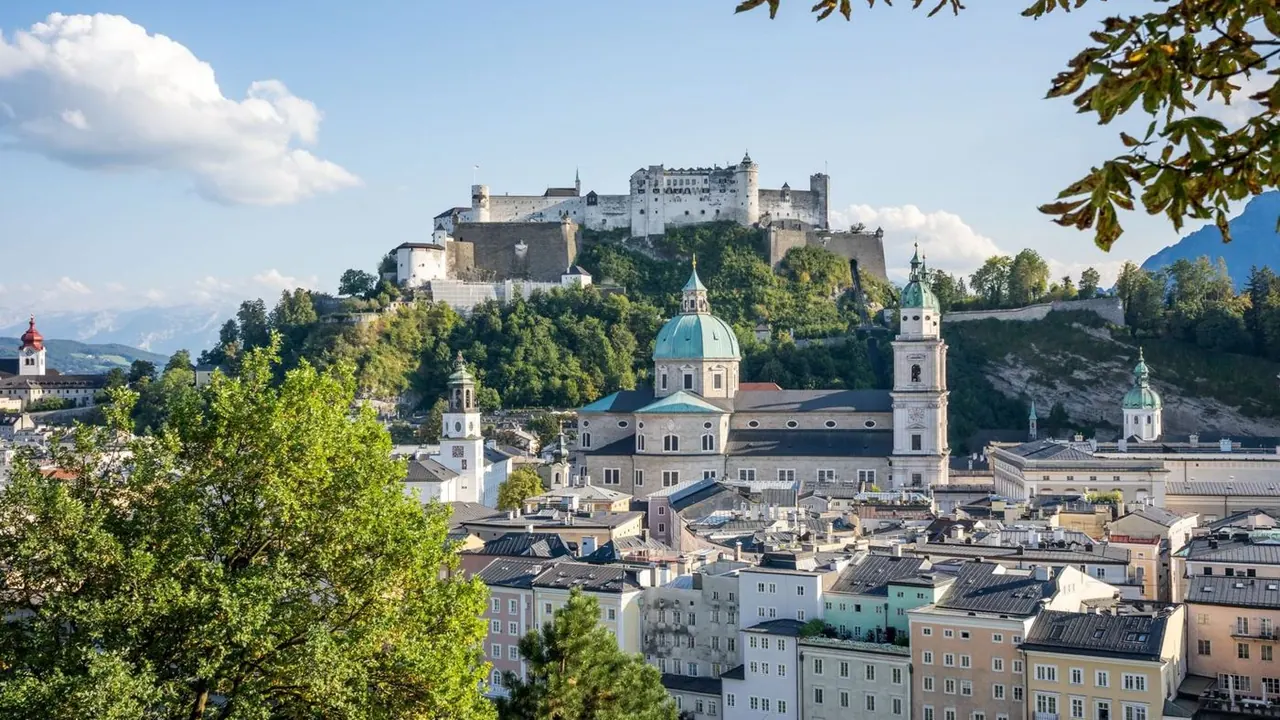
The old town below the fortress
- Nature & outdoors86
- Day trips80
- Live music & the arts80
Photo: Leonhard Niederwimmer, Pexels License
Match
58
Every category weighted equally
- Beach & sun53
- Culture & arts62
- Food & nightlife53
- Family trip60
- Outdoors63
- Relax & unwind58
- Shopping & style57
- On a budget55
Salzburg in twelve categories
Our verdict on each, scored 0 to 100 against the same fixed benchmark cities, so a score means the same thing on every page.
Beaches & swimming. Scores 35 out of 100.
Food & drink. Scores 45 out of 100.
Culture & sights. Scores 72 out of 100.
Nightlife. Scores 25 out of 100.
Nature & outdoors. Scores 86 out of 100.
Day trips. Scores 80 out of 100.
Good for families. Scores 65 out of 100.
Getting around. Scores 72 out of 100.
Shopping & style. Scores 48 out of 100.
Affordability. Scores 32 out of 100.
Live music & performing arts. Scores 80 out of 100.
Wellness & relaxation. Scores 55 out of 100.
Salzburg category by category
Beaches & swimming
35Salzburg is an inland city, and the Salzach running through it is too cold and fast for swimming. In summer, people swim in the lakes. Fuschlsee, Wolfgangsee and Mondsee lie about half an hour to forty-five minutes east in the Salzkammergut. Their water is clear and green, reaches roughly 20-24°C in July and August, and is entered from lawns, wooden jetties and small pebble shores rather than sandy beaches. Closer in, locals use a few ponds and open-air pools on the edge of town.
It makes a pleasant afternoon on a hot day, but the season runs only from June to early September, and lake bathing is an extra on a Salzburg trip rather than a reason to come.
Food & drink
45The food is Austrian and filling: Wiener schnitzel, Tafelspitz, dumplings, Kasnocken with mountain cheese, and the Salzburger Nockerl, a soufflé shaped like three peaks to suggest the hills around town. Coffee houses are the strongest part of the scene. Café Tomaselli, open for three centuries on the Alter Markt, is the classic place for coffee and cake. The Augustiner monastery brewery in Mülln serves its beer from wooden barrels in big halls and a chestnut-shaded garden where you bring your own food.
The old town has many restaurants serving the same menus to tour groups at high prices. Better cooking is found in the inns of the outer districts and on the surrounding hills, and there are a few serious fine-dining kitchens nearby. The range of cuisines is narrow, and a few days covers it.
Culture & sights
72Salzburg's old town is a UNESCO-listed ensemble built by the prince-archbishops, who spent the profits of the salt trade on Italian-style Baroque. The cathedral, the Residenz state rooms and their gallery, and the arcaded squares around them are all a few minutes' walk apart. Hohensalzburg, one of the largest intact medieval fortresses in Europe, stands on the cliff above. Across the river are the Mirabell Palace and its formal gardens. Mozart's birthplace on Getreidegasse and the family's later residence are both museums.
The Benedictine abbey of St Peter has catacombs cut into the rock and an atmospheric cemetery, and the Museum der Moderne sits on the Mönchsberg ridge. Schloss Hellbrunn, with its trick fountains, is a short bus ride south. Everything worth seeing fits into two or three unhurried days.
Nightlife
25Evenings in Salzburg tend to be a concert, a late dinner and a drink, and the old town is quiet by midnight. The beer halls are the best part, with long wooden tables and litre mugs, and they are full of locals as well as visitors. Rudolfskai along the river and a few streets near the university have student pubs and a handful of small bars that stay open later, mainly at weekends during term. Club life is minimal. Anyone wanting a proper night out goes to Munich, about an hour and a half away by train.
Nature & outdoors
86Salzburg sits where the Alps meet the foothills, and the scenery starts at the city limits. Within the centre, the Mönchsberg and Kapuzinerberg are wooded ridges with walking paths and views over the domes. A bike path follows the Salzach through meadows to Hellbrunn and beyond. On the southern edge, a cable car climbs the Untersberg to about 1,800m for limestone ridge walks. The Gaisberg, reached by bus, is used for hiking, trail running and paragliding.
East of the city, the lake district of the Salzkammergut offers sailing, stand-up paddling and lakeside trails among steep green hills. South over the German border, Berchtesgaden National Park and the Königssee fjord are about half an hour away, and the larger ski areas of the Salzburger Land are around an hour's drive. Summer is the main hiking season. In winter, snow often reaches the town.
Day trips
80Day trips from Salzburg cover lake villages, salt-mining heritage and a major German city. Hallstatt is the best-known: a UNESCO-listed village on a narrow strip of shore with a prehistoric salt mine above it, about an hour and a half away. St Wolfgang and St Gilgen are closer and quieter lakeside villages, and Bad Ischl was the imperial summer spa town. In Hallein, twenty minutes south, visitors can go down into a salt mine and visit a Celtic museum. Further up the Salzach, Werfen has a dramatic clifftop fortress.
Across the border, Berchtesgaden has its royal salt works and the Kehlsteinhaus on a summit above it. Munich is about an hour and a half by train, and Linz is a little closer. Some of the lake villages are much easier to reach by car than by bus.
Good for families
65Salzburg is small, safe and calm, so it is easy to manage with children. Most of the centre is car-free, though the cobbles and steep lanes are hard work with a pushchair. Children usually like the trick fountains at Schloss Hellbrunn best, as they spray unsuspecting visitors in the gardens. The zoo is beside the palace, and Haus der Natur in town is a large hands-on museum of natural history and science. The funicular up to the fortress, the marionette theatre and the Sound of Music sites are popular with families too.
Outside the city, the salt mines at Hallein and Berchtesgaden have wooden miners' slides and boat rides on underground lakes, and the summer lakes and alpine pastures make easy outings. There is no theme park nearby, and two or three days covers the city's family attractions.
Getting around
72The heart of Salzburg is small and best seen on foot. The old town, the fortress, Mirabell and the Mozart houses are all within about fifteen minutes' walk of each other, and much of the centre is pedestrianised. A dense network of trolleybuses and buses reaches the rest of the city, including Hellbrunn and the Untersberg cable car. There is no metro or tram system, and the city's flat riverside paths are well suited to cycling.
Trains to Munich, Vienna and Hallein leave from the main station. The Salzkammergut lakes and Berchtesgaden are served by regional buses, but these are slow, which is why many visitors hire a car for the lake villages. You do not need a car within the city itself.
Shopping & style
48Shopping centres on Getreidegasse, a narrow medieval lane hung with wrought-iron guild signs. The chain shops along it are housed in old burgher houses. Salzburg's real specialism is Tracht, traditional Alpine dress. Workshops and shops around the old town sell dirndls, loden jackets and leather goods, many of them made to measure. Other local goods include Mozartkugeln, schnapps, wooden toys and handmade Christmas decorations.
The farmers' market by the Andräkirche and the stalls on Universitätsplatz are good for regional cheese and cured meat. In Advent, the Christmas market on Domplatz is one of the oldest and best-known in the region. Beyond these, the range is limited, there is little luxury shopping, and many old-town shopfronts sell souvenirs.
Affordability
32Salzburg is an expensive city for its size. Hotels in and near the old town cost a lot all year, and during the summer festival and the Advent markets both rooms and restaurant tables become scarce and much more costly. Eating out in the centre is priced well above the Austrian average. The traditional inns and beer halls in the outer districts give better value.
Public transport is moderately priced, and a city card combining transport with most of the museums and the fortress keeps sightseeing costs down. Staying across the river or in the suburbs and coming in by bus is the usual way to save money.
Live music & performing arts
80Mozart's birthplace takes classical music more seriously than almost any city of its size. Every summer the Salzburg Festival fills the Grosses Festspielhaus, the Haus für Mozart and the Felsenreitschule, a riding school carved into the cliff, with opera, orchestral concerts and theatre by leading performers. Jedermann is performed outdoors in front of the cathedral. Mozart Week in winter and the Easter Festival add two further seasons, and festival tickets need planning well in advance.
Outside the festivals, the Mozarteum's concert halls, the Landestheater's opera and drama, and the long-established Marionette Theatre's Mozart operas keep a steady programme going. There are also chamber concerts nearly every evening in the Mirabell Palace and the fortress, aimed at visitors. Jazz and contemporary live music are small by comparison.
Wellness & relaxation
55Salzburg has no thermal springs of its own, but it is a slow-paced city. Once the day-trippers leave, the river paths, the Mirabell gardens and the wooded Mönchsberg are quiet places to walk, and the coffee houses suit an unhurried afternoon. In the city park, the Paracelsus Bad is a public bath with saunas and a pool overlooking the Kapuzinerberg.
The real bathing culture lies just outside the city. Bad Reichenhall, about twenty minutes across the German border, is a historic spa town built on salt-water brine. The Gastein valley, about an hour and a half south, has radon thermal springs and Belle Époque spa hotels. Hotels by the Salzkammergut lakes also offer saunas and spa stays.
When should you go?
Pick a month to see what it is like. The climate figures are measured averages, not a forecast.
Salzburg in July
Daytime high, °C
Rainfall in the month, mm
The whole year
Shaded against this city’s own year: the deepest cell is its best month for that figure and the palest its weakest.
Temperature and rainfall are climate normals, averaged over the years shown. Salzburg: 1991-2020 normals, Salzburg (3.4 km from centre).
Before you go
| Measure | Salzburg |
|---|---|
| Official language | German, Austrian Sign Language |
| Currency | Euro (EUR) |
| Sockets | CF230 V, 50 Hz |
| Driving side | Right |
| Time zone | UTC+1, UTC+2 in summer |
| Emergency number | 112 |
| Elevation | 424 m |
| Main airport | Salzburg Airport (SZG)3 km from centre64 non-stop destinations |
| Public holidays this year | 16 days |
By the numbers
| Measure | Salzburg |
|---|---|
| City population | 155,021 |
| People per km² | 2,360 |
| Museums within 10 km | 38 |
| UNESCO World Heritage sites within 50 km | 3 |
Compare Salzburg with
Every comparison with a written verdict behind it.