Germany
Stuttgart
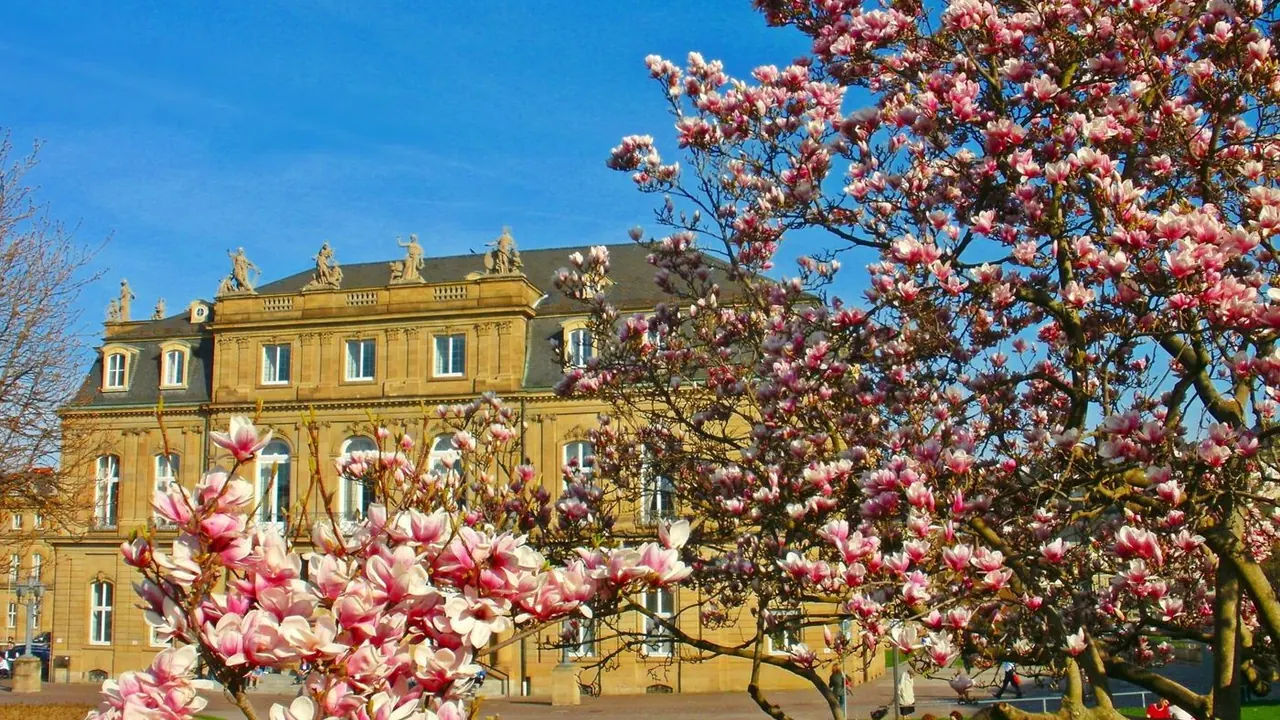
Neues Schloss with magnolias in bloom
- Day trips80
- Live music & the arts74
- Getting around72
Match
57
Every category weighted equally
- Beach & sun51
- Culture & arts63
- Food & nightlife57
- Family trip56
- Outdoors58
- Relax & unwind55
- Shopping & style59
- On a budget55
Stuttgart in twelve categories
Our verdict on each, scored 0 to 100 against the same fixed benchmark cities, so a score means the same thing on every page.
Beaches & swimming. Scores 8 out of 100.
Food & drink. Scores 58 out of 100.
Culture & sights. Scores 62 out of 100.
Nightlife. Scores 42 out of 100.
Nature & outdoors. Scores 60 out of 100.
Day trips. Scores 80 out of 100.
Good for families. Scores 66 out of 100.
Getting around. Scores 72 out of 100.
Shopping & style. Scores 58 out of 100.
Affordability. Scores 40 out of 100.
Live music & performing arts. Scores 74 out of 100.
Wellness & relaxation. Scores 64 out of 100.
Stuttgart category by category
Beaches & swimming
8Stuttgart is far inland, and there is no beach life to speak of. The Neckar runs through the city as a working river with locks and barges, not a place to swim, and the lake at Max-Eyth-See is for strolling and boating, not bathing. In summer, locals swim in the outdoor pools, some of them fed by the city's mineral springs. Lake Constance, the nearest serious stretch of swimmable water, is more than two hours south, so anyone who wants sand and sea should plan a different trip.
Food & drink
58Swabian cooking is hearty and very much its own thing. Maultaschen are large pasta parcels filled with meat and spinach, and they come in broth or fried with onions. Käsespätzle are egg noodles baked with cheese, and Zwiebelrostbraten is roast beef heaped with crisp onions. Traditional wine taverns serve all of this, and so do simpler places in the Bohnenviertel and around the old centre. The Markthalle, an Art Nouveau market hall, is the best place to browse regional produce and delicatessen counters.
Vineyards climb the slopes inside the city limits, so local Trollinger and Riesling are poured everywhere. In season, growers open seasonal Besen taverns in their own houses and serve wine with onion tart. For a city this size there is also a deep fine-dining tier, while cheap street food and international variety are more limited.
Culture & sights
62Stuttgart's sights come out of industry and modern design more than old stones. Most visitors start with the Mercedes-Benz Museum and the Porsche Museum, both striking buildings with collections of real international standing. The Staatsgalerie has a fine run of European painting, and its postmodern extension is a landmark of its own. On the Killesberg hill, the Weissenhof Estate is a 1927 model housing project, and its Le Corbusier houses are part of a UNESCO listing.
The historic core was heavily bombed, so heritage comes in pockets. Schlossplatz is framed by the baroque Neues Schloss, and the Altes Schloss houses the Württemberg State Museum. The Stiftskirche and the Kunstmuseum's glass cube sit nearby. Two to three days covers the essentials.
Nightlife
42Going out in Stuttgart is sociable and solid, but it is not why people come. Most of it happens along Theodor-Heuss-Strasse, a strip of bars and lounges that fills at weekends. The clubs are scattered around the centre, many in basements and former industrial spaces, and electronic music has a small but loyal following. The Bohnenviertel and the streets around Hans-im-Glück-Platz are better for a quieter evening of wine bars and pubs.
The liveliest times of year are the Cannstatter Volksfest in autumn, with its enormous beer tents, and the late-summer wine village in the old centre. On weekdays and outside those festivals the city settles down fairly early.
Nature & outdoors
60Stuttgart sits in a green basin ringed by wooded hills and vineyards, so a walk out of the centre soon climbs into the countryside. Wine trails run along the slopes above the Neckar, and the forests of the Rotwildpark and Schönbuch have deer, lakes and long walking routes. The Neckar valley is good for gentle cycling.
Within about an hour are the limestone escarpments of the Swabian Jura, with cliff-edge trails, caves and juniper heaths. The northern Black Forest, with ridge hikes and dark fir woods, is about the same distance. None of this is high mountain country, but there is plenty for walkers and cyclists in every season, and the Jura is at its best in autumn colour.
Day trips
80Stuttgart is a very good base for day trips. Ludwigsburg, with one of Germany's largest baroque palaces, and the half-timbered old town of Esslingen are both a short S-Bahn ride away. Tübingen, a university town of steep lanes and punts on the Neckar, is under an hour, and the fast train reaches Heidelberg's castle and old town in about forty minutes.
Further out, the Cistercian monastery at Maulbronn is a UNESCO site. Hohenzollern Castle stands on its hilltop south of the city, and Ulm has the world's tallest church spire. Schwäbisch Hall, Bebenhausen abbey and the spa town of Baden-Baden round out the list. Strasbourg is within reach by fast train for a long day across the border.
Good for families
66Stuttgart is an easy, safe and well-organised city for children. Wilhelma, a historic zoological and botanical garden set among Moorish-style pavilions, is the highlight and easily fills a day. The car museums go down well with older children, and the hilltop Killesberg park has a narrow-gauge railway, animal enclosures and a lookout tower. In Ludwigsburg, the palace gardens include a fairy-tale garden built for younger visitors.
The city has plenty of playgrounds, good outdoor pools and child-friendly beer gardens. Its small rack railway is a treat in itself. The central hills mean some climbing with a pushchair, and anyone who wants a big theme park has to travel beyond the city.
Getting around
72The heart of Stuttgart is flat and compact. Königstrasse, Schlossplatz, the Markthalle and the main museums are all within easy walking distance. Beyond that the city climbs steeply up the sides of its basin, and the Stadtbahn light rail and the S-Bahn take over. A single integrated ticket covers both, along with buses, a rack railway and a funicular to the hillside cemetery and forest.
The network reaches everything a visitor needs, including the car museums, Wilhelma and the airport, and many hills have long public stairways called Stäffele as shortcuts on foot. A car is useful only for countryside excursions.
Shopping & style
58Königstrasse is one of the longest pedestrian shopping streets in Germany and runs straight through the centre with the familiar high-street names. Just off it, Breuninger, a family department store founded in the nineteenth century, is the main draw for luxury and designer fashion, and the streets around Calwer Strasse and the Bohnenviertel have smaller independent shops. The Markthalle is good for food gifts and regional wine.
Many visitors also head to Metzingen, about half an hour away, a small town that has become one large outlet village built around the home of a major German fashion house. Crafts and markets are modest, so Stuttgart suits brand shoppers more than browsers.
Affordability
40Stuttgart is a prosperous city, and prices for visitors sit above the middle for Western Europe. Business travel shapes the hotel market, so rooms are expensive during big trade fairs and noticeably cheaper on weekends and in the quieter months. Eating out in traditional taverns and beer gardens is reasonable for the portions, and public transport is fairly priced, especially with a day ticket. Smart restaurants and central hotels are where the budget goes.
Live music & performing arts
74Stuttgart's stage life is far richer than its size suggests. The Staatsoper and the Stuttgart Ballet share the grand state theatre building beside the palace gardens. The opera company has a reputation for bold productions, and the ballet, famous since John Cranko's era, is one of the most respected companies in Europe. The Staatsschauspiel adds serious drama, and the Liederhalle hosts symphony orchestras, chamber music and a strong Bach tradition.
Two large theatres at the Möhringen entertainment complex run long seasons of big musicals, and a well-known jazz club and smaller venues keep live music going through the week. Tickets for the ballet are the hardest to get, so book early.
Wellness & relaxation
64Stuttgart has a genuine bathing culture, which surprises many visitors. The springs of Bad Cannstatt and Berg are among the most productive mineral sources in Europe. They feed public baths such as the Mineralbad Cannstatt and the Mineralbad Leuze, where locals soak in naturally carbonated warm water indoors and out, and the larger baths add saunas.
The city is orderly and green, with vineyard walks and quiet parks close to the centre. Its everyday pace is businesslike rather than slow. A wellness break here means an afternoon in the mineral pools and saunas, not a full spa retreat.
When should you go?
Pick a month to see what it is like. The climate figures are measured averages, not a forecast.
Stuttgart in July
Daytime high, °C
Rainfall in the month, mm
The whole year
Shaded against this city’s own year: the deepest cell is its best month for that figure and the palest its weakest.
Temperature and rainfall are climate normals, averaged over the years shown. Stuttgart: 1991-2020 normals, Stuttgart / Neckartal (2.8 km from centre).
Before you go
| Measure | Stuttgart |
|---|---|
| Official language | German |
| Currency | Euro (EUR) |
| Sockets | CF230 V, 50 Hz |
| Driving side | Right |
| Time zone | UTC+1, UTC+2 in summer |
| Emergency number | 112 |
| Elevation | 245 m |
| Main airport | Stuttgart Airport (STR)10 km from centre124 non-stop destinations |
| Public holidays this year | 12 days |
By the numbers
| Measure | Stuttgart |
|---|---|
| City population | 609,365 |
| People per km² | 2,938 |
| Museums within 10 km | 42 |
| UNESCO World Heritage sites within 50 km | 3 |
Compare Stuttgart with
Every comparison with a written verdict behind it.