Italy
Bologna
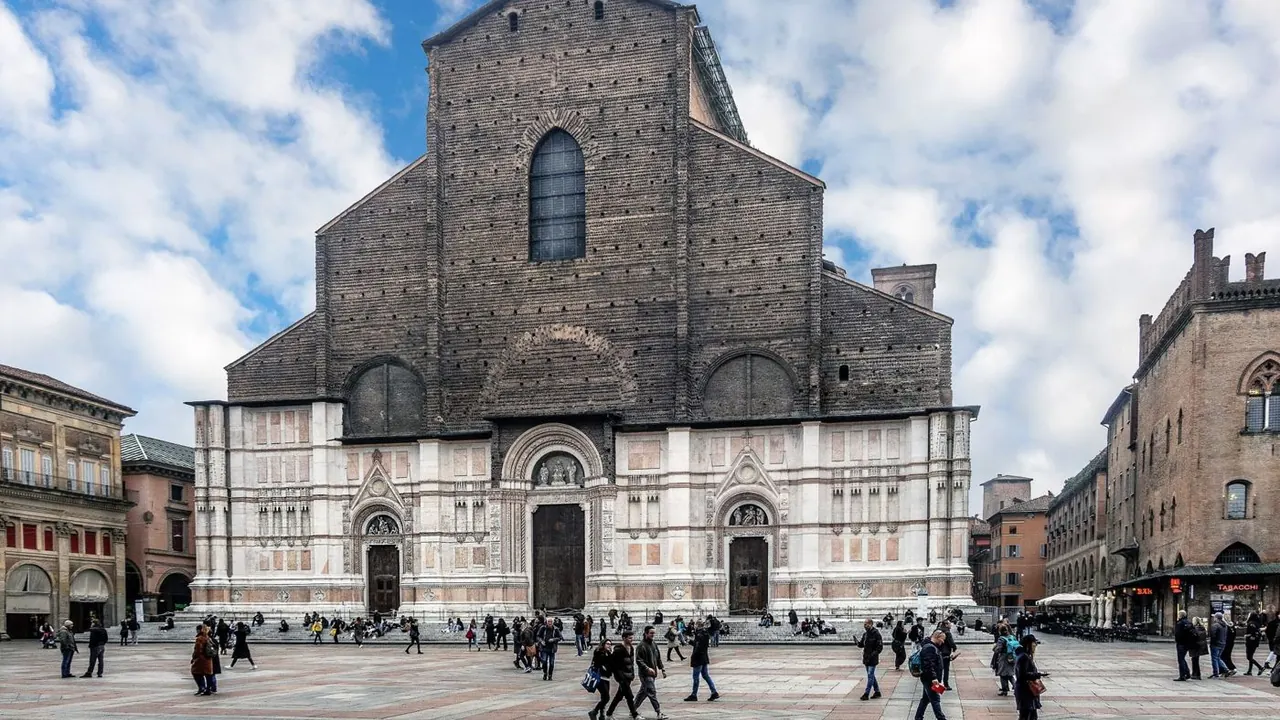
San Petronio on Piazza Maggiore
- Day trips95
- Food & drink82
- Culture & sights77
Photo: Vanni Lazzari, CC BY-SA 4.0, cropped
Match
60
Every category weighted equally
- Beach & sun55
- Culture & arts68
- Food & nightlife65
- Family trip58
- Outdoors62
- Relax & unwind57
- Shopping & style63
- On a budget59
Bologna in twelve categories
Our verdict on each, scored 0 to 100 against the same fixed benchmark cities, so a score means the same thing on every page.
Beaches & swimming. Scores 30 out of 100.
Food & drink. Scores 82 out of 100.
Culture & sights. Scores 77 out of 100.
Nightlife. Scores 58 out of 100.
Nature & outdoors. Scores 52 out of 100.
Day trips. Scores 95 out of 100.
Good for families. Scores 50 out of 100.
Getting around. Scores 76 out of 100.
Shopping & style. Scores 55 out of 100.
Affordability. Scores 48 out of 100.
Live music & performing arts. Scores 60 out of 100.
Wellness & relaxation. Scores 40 out of 100.
Bologna category by category
Beaches & swimming
30Bologna is an inland city on the edge of the Po plain, and beach life plays no part in a stay here. The nearest sea is the Romagna Riviera, with Rimini about an hour away by train and Cervia and Milano Marittima a little further. The Adriatic there is warm in summer, around 25°C in August, shallow and gentle, but the shore is a long strip of rented umbrellas and sunbeds in organised lidos, and the water is often more green than clear.
A seaside day is possible in July and August if the heat in the city gets too much. Anyone who wants swimming to be part of the vacation should stay on the coast itself.
Food & drink
82Bologna is where a lot of Italy's richest cooking comes from, and eating is a main reason to come. Tagliatelle al ragù, tortellini in brodo, lasagne verdi, mortadella and crescentine with cured meats are made here with real care, in family trattorias and old osterie with paper tablecloths. Fresh pasta is still rolled by hand in shop windows, and Parmigiano Reggiano, Parma ham and aged balsamic vinegar come from towns less than an hour away.
The Quadrilatero, the tangle of medieval lanes behind Piazza Maggiore, is the old market district, lined with delicatessens, fishmongers and greengrocers, and the covered Mercato delle Erbe adds food stalls. The evening aperitivo is a ritual, with a glass of Lambrusco or Pignoletto from the nearby hills. What it lacks is range: away from Emilian food the choice is thin, and the cooking is heavy in summer.
Culture & sights
77Bologna's great sight is the city itself: a large, remarkably whole medieval centre in red and ochre brick, with close to 40km of arcaded porticoes that are listed by UNESCO. Piazza Maggiore and the unfinished Basilica of San Petronio form the heart, the leaning Two Towers mark the old crossroads, and the Santo Stefano complex gathers seven churches into one.
The Archiginnasio, the old seat of the oldest university in Europe, holds a wooden anatomical theatre, and the university quarter around Via Zamboni has palaces and small museums. The Pinacoteca Nazionale has a fine collection of Bolognese painting, and a long arcaded walk climbs to the Sanctuary of San Luca on its hill. It all takes two or three days to see well.
Nightlife
58With tens of thousands of students, Bologna goes out more than most Italian cities its size. The university quarter around Piazza Verdi and Via Petroni fills with young crowds standing outside cheap bars, and Via del Pratello is a long street of small taverns and pubs that stays lively until late. Around the Quadrilatero and Via San Vitale the evening starts with aperitivo and moves on to wine bars.
The tone is informal and student-led rather than polished, and serious clubbing means a taxi to venues on the edge of town. In August, when the students leave, the city empties and the nights go very quiet.
Nature & outdoors
52The city sits right where the flat Po plain meets the first green hills of the Apennines. The walk up to San Luca and the paths through the Colli Bolognesi give easy hill walking within reach of the centre, and the Parco dei Gessi just south of town has gypsum caves and karst ridges. The Via degli Dei, a multi-day trail over the mountains to Florence, starts in Piazza Maggiore.
Further south the Apennines rise to around 2,000m at Corno alle Scale, with summer hiking and modest winter skiing about an hour and a half away. North of the city the landscape is flat farmland, good for cycling but not scenic. Summers are hot and humid, so spring and autumn are the times to be outdoors.
Day trips
95Bologna sits at the main rail junction of northern Italy, and that makes it one of the best bases in Europe for day trips. Florence is barely half an hour away by fast train. Ravenna, with its Byzantine mosaics, is about an hour, and Ferrara with its Renaissance walls and castle is closer still. Modena, with its Romanesque cathedral and balsamic vinegar, and Parma, with its baptistery and food producers, are short regional train rides along the Via Emilia.
Further out, Verona, Padua and Venice are each about an hour and a half away, and Mantua is reachable too. Smaller outings include the medieval hill town of Dozza, the Lambrusco and Pignoletto wineries, and the Romagna coast at Rimini.
Good for families
50Bologna is an easy, welcoming city to be in with children, but there is not much made for them. The centre is flat, compact and largely closed to traffic, the porticoes give shade and shelter from rain, and pasta, pizza and gelato make mealtimes simple. Climbing the Asinelli tower or walking the arches up to San Luca can become a small adventure for older children.
Beyond that the sights are churches, palaces and museums aimed at adults, and there is no zoo or large aquarium. Families usually add a day at Mirabilandia, a big theme park near Ravenna, or a trip to the beach at Rimini. The summer heat in the city can be hard on small children.
Getting around
76Almost everything a visitor wants is within the medieval centre, and the centre is small, flat and best seen on foot. The porticoes mean you can walk most streets in shade or out of the rain, and much of the old town is closed to private cars, so a car is more of a burden than a help.
There is no metro. Buses cover the city and the hills, and a shuttle links the airport to the central station. The station is the real asset: it sits at the edge of the old town, with fast and regional trains to the rest of northern Italy. Cycling is common, and the many bikes are worth watching out for under the arches.
Shopping & style
55Shopping in Bologna is mostly about food. The delicatessens of the Quadrilatero sell mortadella, aged Parmigiano, fresh tortellini and balsamic vinegar to take home, and that is what most visitors carry away. Via dell'Indipendenza and Via Rizzoli hold the Italian high-street chains, while Via Farini and the Galleria Cavour arcade gather the luxury fashion houses in a refined but small cluster.
The Montagnola market sells clothes and bric-a-brac several days a week, and an antiques market fills Piazza Santo Stefano on some weekends. Independent shops, bookshops and vintage stores are spread through the university quarter. It is pleasant browsing rather than a reason to come.
Affordability
48Bologna is a mid-priced city for Western Europe. Eating is the good news: trattorias serving honest local cooking, aperitivo with food included and local wine by the glass all cost less than in Italy's main tourist cities. Most sights are churches and squares that are free to enter, and the walkable centre means little is spent on getting around.
Rooms are the expensive part. Hotels in the old town are priced like the rest of prosperous northern Italy, and when one of the large trade fairs is on, rooms become scarce and costly across the city. Booking well ahead, or staying near the station, helps.
Live music & performing arts
60Bologna has a real musical tradition. The Teatro Comunale is one of Italy's historic opera houses, with a season of opera, ballet and symphonic concerts, and the city is recognised by UNESCO as a City of Music. Jazz has a long local history, with small basement clubs playing most nights, and the student population keeps a steady stream of indie and rock gigs in small venues and social centres.
Theatre is mostly in Italian, at the Arena del Sole and smaller stages, so it means little to most visitors. In summer, outdoor concerts and film screenings fill Piazza Maggiore and the city's courtyards. It is a good scene for a city of its size rather than a destination in itself.
Wellness & relaxation
40Bologna has no bathing tradition of its own, and wellness in the city means hotel spas and the slow pleasure of a long lunch under the porticoes. The pace is relaxed by big-city standards, though the university quarter is noisy and the summer heat can be heavy.
Thermal water is close by. Castel San Pietro Terme, about twenty minutes away, has spa pools fed by local springs, and Porretta Terme, in the Apennines about an hour south by train, is an old spa town in a green valley. Both make a calm half day, but neither is a reason to choose Bologna.
When should you go?
Pick a month to see what it is like. The climate figures are measured averages, not a forecast.
Bologna in July
Daytime high, °C
Rainfall in the month, mm
The whole year
Shaded against this city’s own year: the deepest cell is its best month for that figure and the palest its weakest.
Where the figures come from
Bologna has no rain gauge within 25 km of the centre, so its rainfall comes from a gridded climate dataset read at the city rather than from a gauge further away.
Bologna's sunshine is measured 82 km from the centre, at Cervia.
Temperature and rainfall are climate normals, averaged over the years shown. Bologna: 1991-2020 normals, Bologna / Borgo Panigale (5.5 km from centre).
Before you go
| Measure | Bologna |
|---|---|
| Official language | Italian |
| Currency | Euro (EUR) |
| Sockets | CFL230 V, 50 Hz |
| Driving side | Right |
| Time zone | UTC+1, UTC+2 in summer |
| Emergency number | 112 |
| Elevation | 54 m |
| Main airport | Bologna Guglielmo Marconi Airport (BLQ)6 km from centre98 non-stop destinations |
| Public holidays this year | 13 days |
By the numbers
| Measure | Bologna |
|---|---|
| City population | 387,971 |
| People per km² | 2,754 |
| Museums within 10 km | 68 |
| UNESCO World Heritage sites within 50 km | 3 |
Compare Bologna with
Every comparison with a written verdict behind it.
- Amalfi
- Annecy
- Antibes
- Bern
- Bled
- Cannes
- Catania
- Como
- Florence
- Geneva
- Genoa
- Innsbruck
- Interlaken
- La Spezia
- Ljubljana
- Lucerne
- Marseille
- Milan
- Monaco
- Munich
- Naples
- Nice
- Palermo
- Pisa
- Portofino
- Positano
- Rome
- Rovinj
- Saint-Tropez
- Salerno
- Salzburg
- Siena
- Sorrento
- Split
- Turin
- Venice
- Verona
- Zadar
- Zagreb
- Zurich