Italy
Verona
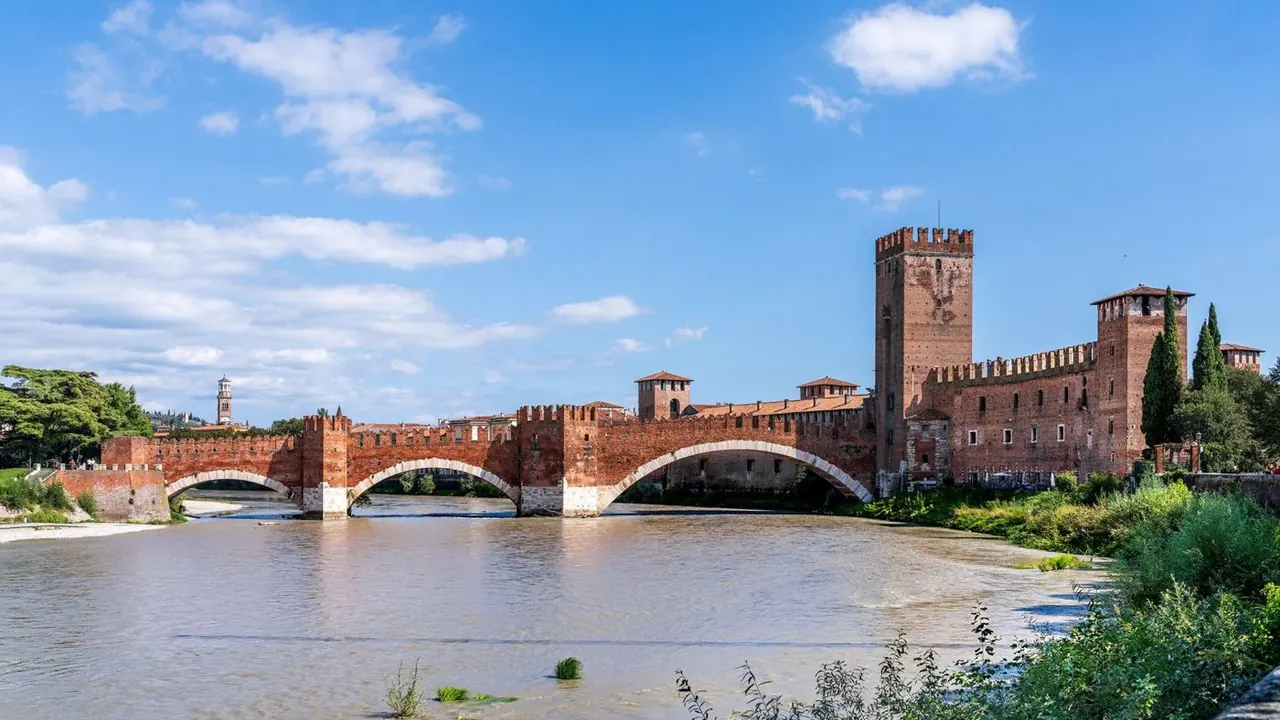
Castelvecchio and Ponte Scaligero over the Adige
- Day trips92
- Culture & sights76
- Getting around68
Photo: NorbertNagel, CC BY-SA 4.0, cropped
Match
61
Every category weighted equally
- Beach & sun57
- Culture & arts65
- Food & nightlife59
- Family trip62
- Outdoors64
- Relax & unwind59
- Shopping & style60
- On a budget59
Verona in twelve categories
Our verdict on each, scored 0 to 100 against the same fixed benchmark cities, so a score means the same thing on every page.
Beaches & swimming. Scores 44 out of 100.
Food & drink. Scores 66 out of 100.
Culture & sights. Scores 76 out of 100.
Nightlife. Scores 37 out of 100.
Nature & outdoors. Scores 65 out of 100.
Day trips. Scores 92 out of 100.
Good for families. Scores 66 out of 100.
Getting around. Scores 68 out of 100.
Shopping & style. Scores 52 out of 100.
Affordability. Scores 46 out of 100.
Live music & performing arts. Scores 66 out of 100.
Wellness & relaxation. Scores 48 out of 100.
Verona category by category
Beaches & swimming
44Verona has no coast, but Lake Garda is close enough to make swimming a real option in summer. The southern shore around Peschiera, Lazise and Bardolino is about half an hour by car or a short train ride to Peschiera, and by July the lake reaches around 24°C, calm and clear with no tides or surf. Lidos with sunbeds, grassy lawns running down to the water and small pebble beaches are the usual setting, with Sirmione's flat limestone shelves a favourite.
It stays a side trip, though. Beaches are narrow and busy on summer weekends, the season runs roughly June to September, and few visitors base themselves in Verona for the water. Those who want lake life every day usually stay on Garda itself.
Food & drink
66Eating in Verona means the cooking of the Veneto hinterland rather than the lagoon: risotto made with Amarone or with Vialone Nano rice from the plain to the south, bigoli pasta with duck or sardines, bollito misto with pearà, a peppery bread-and-marrow sauce, and the old dish of pastissada, horse stewed in red wine. Gnocchi have their own carnival here. Traditional osterie in the lanes around Piazza delle Erbe and across the river in Veronetta serve this food in plain wood-panelled rooms.
Wine is the real strength. Valpolicella, Amarone, Ripasso, Soave and Bardolino are all made within a short drive, and the evening ritual is a glass or a spritz with cicchetti-style snacks at a counter. What the city lacks is breadth: little street food, a limited international range and a fair amount of tired tourist cooking around the Arena.
Culture & sights
76Verona's centre is a UNESCO-listed layering of Roman, medieval and Renaissance city inside a loop of the Adige. The Roman Arena, among the best preserved amphitheatres anywhere, dominates Piazza Bra, and nearby the Roman theatre climbs the hillside across the river below Castel San Pietro. Piazza delle Erbe, on the old forum, and the quieter Piazza dei Signori with the Scaliger tombs carry the mark of the della Scala lords who ruled the city in the Middle Ages.
The Basilica of San Zeno, with its bronze doors and rose window, is one of the finest Romanesque churches in Italy, and Sant'Anastasia and the Duomo add Gothic and older layers. Castelvecchio, a brick fortress with a bridge over the river, holds the main art museum in a celebrated Carlo Scarpa setting. Juliet's balcony draws the crowds, but most of the city's worth lies elsewhere, and it can all be seen in two or three unhurried days.
Nightlife
37Evenings in Verona centre on the aperitivo: spritz and a glass of Valpolicella at tables spilling into Piazza delle Erbe, the lanes around Corso Porta Borsari and the riverside. Across the Ponte Pietra, the university quarter of Veronetta has cheaper, younger wine bars and pubs that stay busier later, especially in term time.
Beyond that, the night is modest. There are a few late cocktail bars and some clubs on the outskirts, but no real dance scene in the centre, and on most nights the streets thin out well before the small hours. In summer the opera crowd leaving the Arena near midnight gives the centre a late second wind.
Nature & outdoors
65Verona sits where the Po plain meets the first foothills of the Alps, and that shapes what lies around it. The Valpolicella hills, with vineyards, cypresses and villages just north of the city, are good for gentle walking and cycling, and the Adige valley carries a long cycle route north towards Trento. Within the city, the climb to Castel San Pietro and the Giardino Giusti give a green escape with views over the rooftops.
An hour away lies Lake Garda, where Monte Baldo rises steeply above the eastern shore, with ridge walks, paragliding and, at the northern end, some of Europe's most reliable wind for sailing and windsurfing. The Lessinia plateau offers pastures, beech woods and limestone gorges for hiking. The Dolomites are further than a comfortable day.
Day trips
92Few cities make a better base for days out. Venice is about an hour and ten minutes by train, close enough for an early start and a late return. Vicenza, with Palladio's villas and Teatro Olimpico, is under half an hour away, Padua with Giotto's Scrovegni Chapel about forty-five minutes, and Gonzaga Mantua, ringed by its lakes, under an hour to the south. Bologna and Milan are both within reach for a longer day.
Closer still, the Lake Garda towns of Sirmione, with its castle and Roman villa ruins, Bardolino, Lazise and Malcesine make easy outings, and the wine country is on the doorstep: Valpolicella's cellars and villas to the north, the walled town of Soave to the east. Variety is the point, from art cities to lakeside harbours to tastings, with the rail line doing most of the work.
Good for families
66The main draws for children lie just outside the city. Gardaland, Italy's biggest theme park, is near Castelnuovo del Garda about half an hour away, with water parks and smaller attraction parks clustered around the southern shore of Lake Garda. Parco Natura Viva, a large zoo with a drive-through safari section, is in the hills at a similar distance, and the lake itself offers calm, shallow swimming.
In town, the Arena and the Roman theatre usually catch a child's imagination, and the largely pedestrian centre is compact, flat and easy with a pushchair. Italian warmth towards children helps everywhere. The sights are otherwise aimed at adults, summer afternoons can be very hot, and most of the family attractions need a car or a transfer.
Getting around
68Verona is a walking city. The historic centre within the river loop is small, flat and largely closed to traffic, so the Arena, Piazza delle Erbe, the churches and Castelvecchio are all within a short stroll of one another, and crossing to Veronetta and the Roman theatre takes minutes. Porta Nuova station sits about twenty minutes' walk south of Piazza Bra, linked by frequent city buses.
There is no metro or tram, and buses are what most visitors use only for the station or the airport. For trips further out, the rail network is excellent towards Venice, Milan and Peschiera on the lake. The Valpolicella villages, the Lessinia and some Garda attractions are served thinly by bus, and a car makes those far easier. Driving into the centre is restricted and best avoided.
Shopping & style
52Via Mazzini, the marble-paved street between Piazza Bra and Piazza delle Erbe, is Verona's shopping spine, lined with Italian fashion and accessory labels, and Corso Porta Borsari and Corso Sant'Anastasia carry smaller boutiques, jewellers and shoe shops. The overall feel is smart and provincial rather than a fashion destination.
The stalls in Piazza delle Erbe sell mostly souvenirs and fruit, and the best things to carry home are edible and drinkable: Amarone and Valpolicella from wine shops, local olive oil from the Garda shore, and the pandoro, a star-shaped Christmas cake the city claims as its own. Serious shoppers make the trip to Milan.
Affordability
46Verona is middling to pricey for its size. Everyday eating is fair, especially in Veronetta's student osterie and at wine counters where a glass comes with a snack, and since the centre is walkable, transport costs little. Local wines are good value compared with what they cost abroad.
Rooms are the main expense. Hotels inside the historic centre are expensive for a provincial city, and on opera nights in summer and during the big trade fairs they become scarce and dear. Restaurants on Piazza Bra and around the Arena charge for the view. Staying near the station or across the river softens the bill.
Live music & performing arts
66Opera in the Roman Arena is one of Europe's great summer experiences: on most evenings from June to early September, grand productions of Verdi, Puccini and Bizet play to thousands seated on the ancient stone tiers, with candles lit as darkness falls and a performance that runs close to midnight. It is spectacle first, with vast sets and choruses, and the reason many people come to Verona at all.
Outside the festival, the scene is that of a cultured provincial city. The eighteenth-century Teatro Filarmonico holds an opera and concert season through the cooler months, and in summer the Roman theatre hosts a long-running festival of Shakespeare, dance and jazz under the stars. Between autumn and spring a visitor finds a modest programme rather than a great one.
Wellness & relaxation
48Verona has no bathing tradition of its own, but warm springs rise around it. Sirmione on Lake Garda has long been a spa town, its sulphurous waters piped into a modern thermal centre with pools facing the lake, and near Lazise a thermal park wraps a warm spring-fed lake in an old villa garden. Closer still, the springs at Caldiero east of the city have been used since Roman times.
Within town, the restorative side is about pace: long lunches, an evening passeggiata along the river, and quiet corners such as the Giardino Giusti's terraces. Summer crowds around the Arena and Juliet's house are the exception to an otherwise gentle city.
When should you go?
Pick a month to see what it is like. The climate figures are measured averages, not a forecast.
Verona in July
Daytime high, °C
Rainfall in the month, mm
The whole year
Shaded against this city’s own year: the deepest cell is its best month for that figure and the palest its weakest.
Temperature and rainfall are climate normals, averaged over the years shown. Verona: 1991-2020 normals, Verona / Villafranca (11.6 km from centre).
Before you go
| Measure | Verona |
|---|---|
| Official language | Italian |
| Currency | Euro (EUR) |
| Sockets | CFL230 V, 50 Hz |
| Driving side | Right |
| Time zone | UTC+1, UTC+2 in summer |
| Emergency number | 112 |
| Elevation | 59 m |
| Main airport | Verona Villafranca Valerio Catullo Airport (VRN)10 km from centre96 non-stop destinations |
| Public holidays this year | 13 days |
By the numbers
| Measure | Verona |
|---|---|
| City population | 255,588 |
| People per km² | 1,285 |
| Museums within 10 km | 18 |
| UNESCO World Heritage sites within 50 km | 5 |
Compare Verona with
Every comparison with a written verdict behind it.