Switzerland
Lucerne
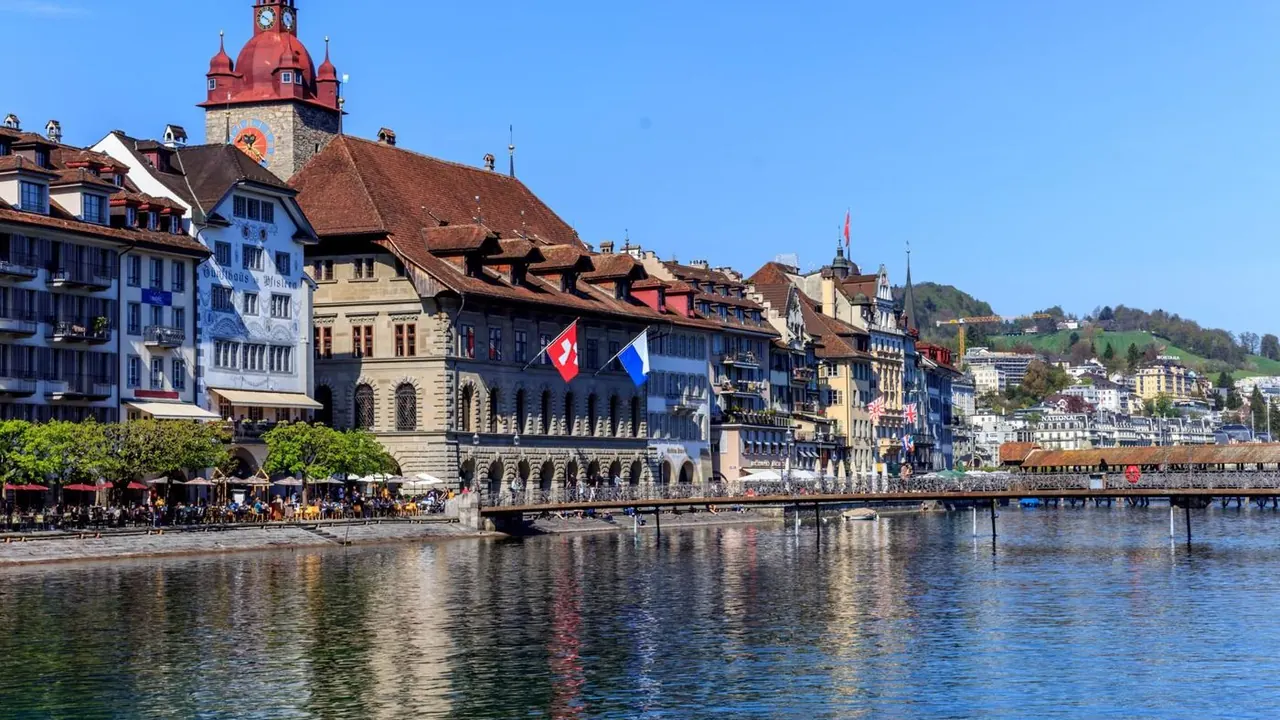
Rathausquai on the Reuss
- Nature & outdoors92
- Getting around86
- Day trips78
Photo: ILOVESwitzerland, Pexels License
Match
54
Every category weighted equally
- Beach & sun49
- Culture & arts57
- Food & nightlife49
- Family trip56
- Outdoors60
- Relax & unwind53
- Shopping & style53
- On a budget49
Lucerne in twelve categories
Our verdict on each, scored 0 to 100 against the same fixed benchmark cities, so a score means the same thing on every page.
Beaches & swimming. Scores 35 out of 100.
Food & drink. Scores 35 out of 100.
Culture & sights. Scores 58 out of 100.
Nightlife. Scores 28 out of 100.
Nature & outdoors. Scores 92 out of 100.
Day trips. Scores 78 out of 100.
Good for families. Scores 66 out of 100.
Getting around. Scores 86 out of 100.
Shopping & style. Scores 46 out of 100.
Affordability. Scores 8 out of 100.
Live music & performing arts. Scores 66 out of 100.
Wellness & relaxation. Scores 46 out of 100.
Lucerne category by category
Beaches & swimming
35There is no sea here, but Lake Lucerne gives the city a real summer bathing culture. On warm days locals swim from the Lido and the old wooden lake baths near the centre, and from the grassy shore at Ufschötti, and in July and August the water usually reaches about 20-22°C. It is clean, calm and backed by mountains, and the lakeside villages reached by boat have their own small bathing spots.
The season is short, though, and the shore is mostly lawns and jetties, not sand. Outside high summer the lake is too cold for most people. Think of a swim as a pleasant break between excursions, not a beach vacation.
Food & drink
35Eating in Lucerne is solid Swiss comfort food more than a reason to come. The local speciality is Chügelipastete, a puff-pastry vol-au-vent filled with veal and mushrooms in cream sauce. Fondue, raclette, rösti and lake fish such as perch and whitefish fill the menus of the old guild houses and wood-panelled taverns in the Old Town. Riverside terraces along the Reuss are good for a long coffee or a glass of Swiss white wine.
The range is narrow for a city, and many of the restaurants around the Chapel Bridge serve the large coach-tour crowds. The Saturday market along the river and a handful of modern bistros in the Neustadt add some variety. Expect good quality and high prices, but not much depth.
Culture & sights
58Lucerne's sights are few, but some are among the best known in Switzerland. The covered wooden Chapel Bridge, with its painted gable panels and the octagonal Water Tower, crosses the Reuss at the heart of a well-kept medieval Old Town of frescoed squares and guild houses. The Musegg Wall above it keeps nine towers, several of which you can climb. The Lion Monument, a dying lion carved into a sandstone cliff, is a moving memorial to the Swiss Guards killed in 1792.
The Rosengart Collection has a strong set of Picasso and Klee. The Bourbaki Panorama, the Baroque Jesuit Church and Wagner's lakeside villa at Tribschen add more. Jean Nouvel's lakefront concert hall is the modern landmark. You can see it all in a day or two.
Nightlife
28Evenings in Lucerne are mostly about a drink by the water after dinner. The Old Town and the riverside have pubs and wine bars, and the Neustadt and the streets near the station hold a few cocktail bars and a small club scene. Students keep things going on weekends.
Outside those nights the city goes quiet early, and by midnight the lakefront is mostly empty. The big exception is Fasnacht, the carnival before Lent, when the whole town is out in costume until dawn. Anyone who wants clubbing or a late bar crawl will find little choice here, and it suits a slow evening better than a big night out.
Nature & outdoors
92Lucerne's setting is its biggest draw. The city sits where the Reuss leaves a long, branching lake hemmed in by mountains, and the peaks are close. Pilatus, at 2,128m, is reached by the world's steepest cogwheel railway on one side and a cable car from the suburbs on the other. Rigi, across the water, has Europe's oldest mountain railway and wide ridge walks. The Stanserhorn has an open-top cable car, and Titlis, with glacier and year-round snow, is about an hour away via Engelberg.
Paddle steamers link the lakeside villages, and that makes it easy to combine boat, rail and hike in one day. Summer and early autumn are best for hiking, and winter brings skiing and sledging. Low cloud can hide the views for days.
Day trips
78Lucerne sits in the middle of Switzerland's rail network, and several of its best towns are easy to reach. Zurich is under an hour by train, and so are Bern, whose arcaded old town is a UNESCO site, and Basel with its Rhine-side old town and big art museums. Closer by, Zug has a pretty lakefront old town, and the Baroque monastery at Einsiedeln is a classic pilgrimage outing.
The lake itself is a day trip. Boats call at Weggis, Vitznau and Brunnen and go on to the Rütli meadow and Altdorf, the heart of the William Tell story and the founding of the Swiss Confederation. Interlaken is about two hours away over the Brünig Pass on a scenic line.
Good for families
66Lucerne works well with children, though the list of things made for them is short. The Swiss Museum of Transport on the lakeshore is the one big draw, a large hands-on collection of trains, planes, ships and cars with a planetarium, and it easily fills a day. The Glacier Garden next to the Lion Monument has glacial potholes and an old mirror maze, and the wildlife park at Goldau is about half an hour away.
Much of the rest is the journeys: paddle steamers, cogwheel trains up Pilatus and Rigi, and a summer toboggan run on Pilatus. These depend on clear weather and add up quickly in cost. The centre is small, flat along the river and very safe, and the lakeside lawns make easy stops for play and picnics. There is no zoo or aquarium, so a long stay can run short of ideas on rainy days.
Getting around
86Lucerne is a pleasure to get around. The station, the boat piers and the start of the Old Town all sit together on the lakefront, and most sights are a short, flat walk along the river. Some streets climb towards the Musegg Wall. City buses reach the Transport Museum and the suburbs, and everything runs on integrated Swiss tickets.
The main excursions are part of the same system. Lake steamers leave from in front of the station, and trains, cogwheel railways and cable cars connect up the lake and into the mountains, so you never need a car. Trips that combine boat, rail and cable car take some reading of the connections, but they are reliable.
Shopping & style
46Shopping in Lucerne means Swiss watches above all. Large jewellery and watch houses line Schwanenplatz and the lakefront, catering to tour groups, alongside shops selling army knives, chocolate, cuckoo clocks and embroidered souvenirs. The Old Town lanes add a few independent boutiques, and the Saturday riverside market sells local produce and some crafts.
Beyond the watch trade the offer is thin. There are few fashion labels or design shops, no department store worth a visit, and the main streets are short. A visitor looking for clothes or homeware will find the basics and not much more.
Affordability
8Lucerne is a very expensive place to visit. Hotel rooms in the centre are costly, especially in summer and during the music festival. Even a simple restaurant meal is pricey by international standards, and the mountain railways and cable cars that make the stay worthwhile are a big part of the budget. Swiss travel passes cover lake boats and some excursions, and supermarket picnics by the lake help. Still, there is no way to make this a budget trip.
Live music & performing arts
66For classical music, Lucerne punches far above its size. The Lucerne Festival, held mainly in late summer with shorter seasons at other times of the year, brings the world's leading orchestras and soloists to Jean Nouvel's lakefront concert hall. The hall is famous for its acoustics and has its own year-round programme. The Lucerne Symphony Orchestra plays there, and the city theatre stages opera, drama and dance.
Outside the festival weeks the programme is that of a small, cultured city. It is good, but not deep. Fasnacht fills the Old Town with brass Guggenmusik bands, and a blues festival and some jazz add to the calendar, but there is little nightly live music.
Wellness & relaxation
46Lucerne has no thermal baths or bathhouse tradition of its own, and spa time means hotel spas and the luxury resorts on the slopes above the lake. A mineral bath designed by Mario Botta high on the Rigi, about an hour away by boat and cogwheel train, is the best place to soak with a mountain view.
What the city does offer is calm. Evenings are quiet, the lakeside promenades are made for slow walks, and a steamer trip with nothing to do but watch the shore is a restful way to spend an afternoon. The old wooden lake baths are a simple summer pleasure. The Old Town is crowded in the middle of the day, though, when the tour groups arrive.
When should you go?
Pick a month to see what it is like. The climate figures are measured averages, not a forecast.
Lucerne in July
Daytime high, °C
Rainfall in the month, mm
The whole year
Shaded against this city’s own year: the deepest cell is its best month for that figure and the palest its weakest.
Where the figures come from
Lucerne has no rain gauge within 25 km of the centre, so its rainfall comes from a gridded climate dataset read at the city rather than from a gauge further away.
Lucerne's sunshine is measured 42 km from the centre, at Zurich Town / Ville..
Temperature and rainfall are climate normals, averaged over the years shown. Lucerne: 2005-2025 (sunshine 1991-2020, rainfall 1991-2020) normals, Emmen (4.2 km from centre).
Before you go
| Measure | Lucerne |
|---|---|
| Official language | French, German, Italian, Romansh |
| Currency | Swiss Franc (CHF) |
| Sockets | CJ230 V, 50 Hz |
| Driving side | Right |
| Time zone | UTC+1, UTC+2 in summer |
| Emergency number | 112 |
| Elevation | 436 m |
| Main airport | Zürich Airport (ZRH)49 km from centre226 non-stop destinations |
| Public holidays this year | 12 days |
By the numbers
| Measure | Lucerne |
|---|---|
| City population | 86,234 |
| People per km² | 2,963 |
| Museums within 10 km | 14 |
| UNESCO World Heritage sites within 50 km | 1 |
Compare Lucerne with
Every comparison with a written verdict behind it.