Italy
Genoa
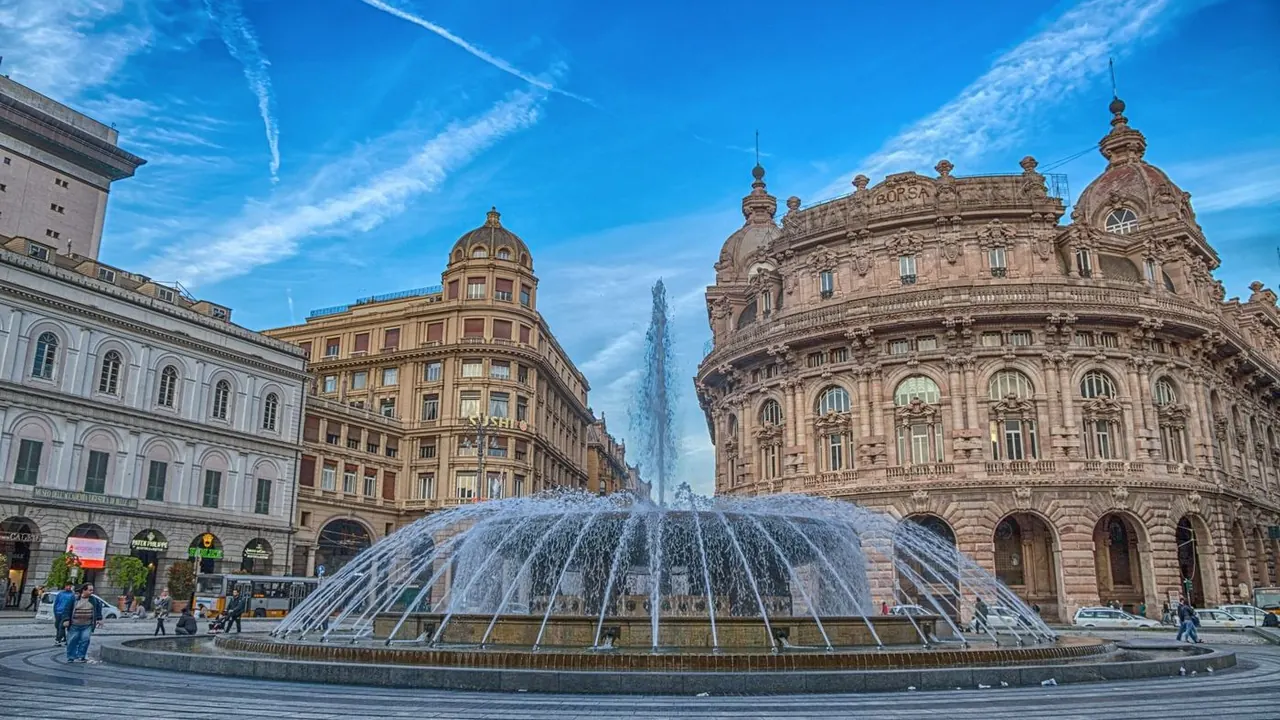
The fountain in Piazza De Ferrari
- Day trips83
- Nature & outdoors78
- Culture & sights76
Photo: Faber1893, CC BY-SA 4.0, cropped
Match
61
Every category weighted equally
- Beach & sun60
- Culture & arts63
- Food & nightlife59
- Family trip65
- Outdoors67
- Relax & unwind60
- Shopping & style60
- On a budget60
Genoa in twelve categories
Our verdict on each, scored 0 to 100 against the same fixed benchmark cities, so a score means the same thing on every page.
Beaches & swimming. Scores 62 out of 100.
Food & drink. Scores 72 out of 100.
Culture & sights. Scores 76 out of 100.
Nightlife. Scores 42 out of 100.
Nature & outdoors. Scores 78 out of 100.
Day trips. Scores 83 out of 100.
Good for families. Scores 64 out of 100.
Getting around. Scores 66 out of 100.
Shopping & style. Scores 48 out of 100.
Affordability. Scores 55 out of 100.
Live music & performing arts. Scores 52 out of 100.
Wellness & relaxation. Scores 35 out of 100.
Genoa category by category
Beaches & swimming
62Genoa is a port city first, but swimming is never far away. Within the city, the fishing hamlet of Boccadasse has a tiny pebble cove, the long Corso Italia seafront is lined with bathing establishments built over the rocks, and Nervi to the east has swimming platforms below its clifftop promenade. The water is clear and reaches about 25°C in August, and the season runs from June into September.
The better swimming is a short train ride along the Riviera: Camogli, Santa Margherita, Rapallo and the twin bays of Sestri Levante to the east, and longer sandy beaches at Varazze to the west. Most shores are pebble or coarse sand, much of the space is taken by rented loungers, and summer weekends are crowded. It suits a visitor who wants a swim most afternoons alongside the city, rather than a beach vacation.
Food & drink
72This is the home of pesto, and the cooking is built on Ligurian herbs, olive oil, chickpeas and the sea. Breakfast is a slab of oily focaccia dunked in cappuccino; lunch might be trofie or trenette with pesto, pansoti in walnut sauce, or cima, the stuffed veal served cold. In the narrow lanes of the old town, old-style friggitorie and farinata shops sell chickpea flatbread, fried fish and panissa fritters by the slice, the city's true street food.
The Mercato Orientale, a covered market in a former cloister, is the place to see what the region grows. Seafood is excellent in the harbour trattorias and in the fishing hamlets along the coast, and Vermentino and Pigato are the white wines to drink with it. The range is regional rather than global, and the top tier of fine dining is thin, but eating well here is easy and very local.
Culture & sights
76Genoa's historic centre is one of the largest medieval quarters in Europe, a dense maze of lanes called caruggi, so narrow and tall that they stay in shade at midday. Above it run the Strade Nuove, Via Garibaldi and Via Balbi, lined with the Renaissance and Baroque palaces of the Rolli system, now a UNESCO site. Palazzo Rosso, Palazzo Bianco and Palazzo Tursi hold Van Dyck, Rubens and Paganini's violin, and their painted halls are as much the attraction as the paintings.
The striped Cathedral of San Lorenzo, the Palazzo Ducale, the Palazzo Reale and the old harbour with its Lanterna lighthouse and maritime museum fill out the centre. The Staglieno monumental cemetery, with its marble sculpture, is one of the most remarkable sights in the city. The palace museums are a pleasure rather than world-famous, and few visitors know how much there is until they arrive.
Nightlife
42Evenings centre on the old town, where students and locals fill the small bars around Piazza delle Erbe and the lanes near the university, drinking aperitivo and spilling into the squares until late on weekends. The Porto Antico and the Foce seafront add waterfront bars, and in summer the action moves towards the Corso Italia and the beach clubs along the coast.
The club scene is small and the city is reserved by Italian standards, with an older population and quiet weeknights. It suits a relaxed aperitivo and a late glass of wine in a medieval square rather than a big night out.
Nature & outdoors
78Genoa is squeezed between steep green hills and the sea, and walking out of it is easy. A funicular climbs to Righi, where a trail links the ring of old fortresses on the ridges above the city with views over the port. East along the coast, the Portofino promontory is a protected park with cliff paths down to the abbey at San Fruttuoso, and the Cinque Terre's terraced trails are within reach by train.
Inland, the Ligurian Apennines and the Beigua Geopark offer quieter hiking and mountain biking. Boats leave the harbour for whale and dolphin watching in the protected Pelagos Sanctuary, and the coast suits kayaking and diving. Spring and autumn are the best walking seasons, when the paths are cooler and less crowded.
Day trips
83Few cities have such a run of famous places on the same railway line. East along the Riviera di Levante, Camogli, Santa Margherita and Portofino are under an hour away, Sestri Levante a little further, and the five villages of the Cinque Terre about an hour and a half by train. Westward, the walled medieval town of Finale Ligure Borgo, the small seaside town of Noli and the old towers of Albenga show a quieter side of the coast.
Inland, Milan and Turin are each about an hour and a half by train, close enough for a museum day or the Last Supper. The Certosa di Pavia and the spa town of Acqui Terme add variety. The coastal trips are the highlight, and in summer they are best started early.
Good for families
64The Porto Antico is the family heart of the city. The Aquarium of Genoa, one of the largest in Europe, can fill half a day with its dolphins, sharks and penguins, and next to it are a children's science centre, a glass biosphere of tropical plants, a panoramic lift and the Galata maritime museum with its walk-through submarine. Funiculars and the old public lifts are a treat for children in themselves.
Beyond the harbour, the city is harder going. The old town's lanes are steep, dark and not built for pushchairs, the hills mean lots of stairs, and green space is limited apart from the Nervi parks. Swimming coves nearby and gelato everywhere help, and Italians welcome children in every restaurant.
Getting around
66Most of what a visitor wants is in the old town and the Porto Antico, which are best explored on foot, though the lanes are a maze and the city climbs steeply from the water. Funiculars, a rack railway and public lifts carry people up to the hillside neighbourhoods, and a single short metro line runs along the valley through the centre.
Buses fill the gaps but are slow in the narrow, congested streets. The regional railway along the coast is the most useful link, reaching Nervi, Boccadasse's neighbourhood and the Riviera towns without a car. Driving and parking in the centre are best avoided.
Shopping & style
48Via XX Settembre, lined with arcades, is the main shopping street, and Via Roma and the Galleria Mazzini arcade hold the smarter Italian labels. The more interesting shopping is in the old town, where long-established shops sell candied fruit, olive oil, pesto and focaccia, and small workshops make silver filigree, coral and ceramics.
The Mercato Orientale is good for food to take home. Beyond that the range is solid but limited: the fashion offer covers the familiar Italian names without much luxury depth or a real design scene, so it suits browsing for local food and crafts more than a dedicated shopping trip.
Affordability
55For northern Italy, Genoa is reasonably priced. Focaccia and farinata make for very cheap meals, trattoria lunches are fair, and central hotels cost less than in the country's most visited cities. Public transport, including the funiculars and lifts, is inexpensive.
Prices climb in the smart resort towns along the Riviera, above all in summer, and paying for a lounger at a bathing establishment adds up on beach days. Overall it is a mid-range city that feels good value for Italy.
Live music & performing arts
52The Teatro Carlo Felice, rebuilt after wartime bombing behind its original colonnade on Piazza De Ferrari, is the city's opera house, with a season of opera, ballet and symphonic concerts. The Teatro Nazionale di Genova is one of Italy's established drama companies, though its plays are in Italian.
Genoa is Paganini's city and celebrates him with concerts, and it gave Italy a generation of singer-songwriters whose tradition lingers in small live-music clubs. There is a decent programme for an evening or two, but not a scene to plan a trip around.
Wellness & relaxation
35Genoa has no bathing culture of its own, and spas are mostly in the better hotels. The nearest thermal waters are at Acqui Terme, a historic spa town in the Piedmont hills a little over an hour away.
The city's calmest corner is Nervi, with its seafront promenade and quiet villa gardens, and the Riviera villages invite long slow lunches. The centre itself, with its port, traffic and crowded lanes, is lively rather than restful.
When should you go?
Pick a month to see what it is like. The climate figures are measured averages, not a forecast.
Genoa in July
Daytime high, °C
Rainfall in the month, mm
The whole year
Shaded against this city’s own year: the deepest cell is its best month for that figure and the palest its weakest.
Where the figures come from
Genoa has no rain gauge within 25 km of the centre, so its rainfall comes from a gridded climate dataset read at the city rather than from a gauge further away.
Genoa's sunshine is measured 80 km from the centre, at Capo Mele.
Temperature and rainfall are climate normals, averaged over the years shown. Genoa: 1991-2020 normals, Genova / Sestri (6.7 km from centre).
Before you go
| Measure | Genoa |
|---|---|
| Official language | Italian |
| Currency | Euro (EUR) |
| Sockets | CFL230 V, 50 Hz |
| Driving side | Right |
| Time zone | UTC+1, UTC+2 in summer |
| Emergency number | 112 |
| Elevation | 20 m |
| Main airport | Genoa Cristoforo Colombo Airport (GOA)7 km from centre25 non-stop destinations |
| Public holidays this year | 13 days |
By the numbers
| Measure | Genoa |
|---|---|
| City population | 558,745 |
| People per km² | 2,325 |
| Museums within 10 km | 51 |
| UNESCO World Heritage sites within 50 km | 1 |
| Swim season, months above 21 °C | 4 months |
Compare Genoa with
Every comparison with a written verdict behind it.