Italy
Trieste
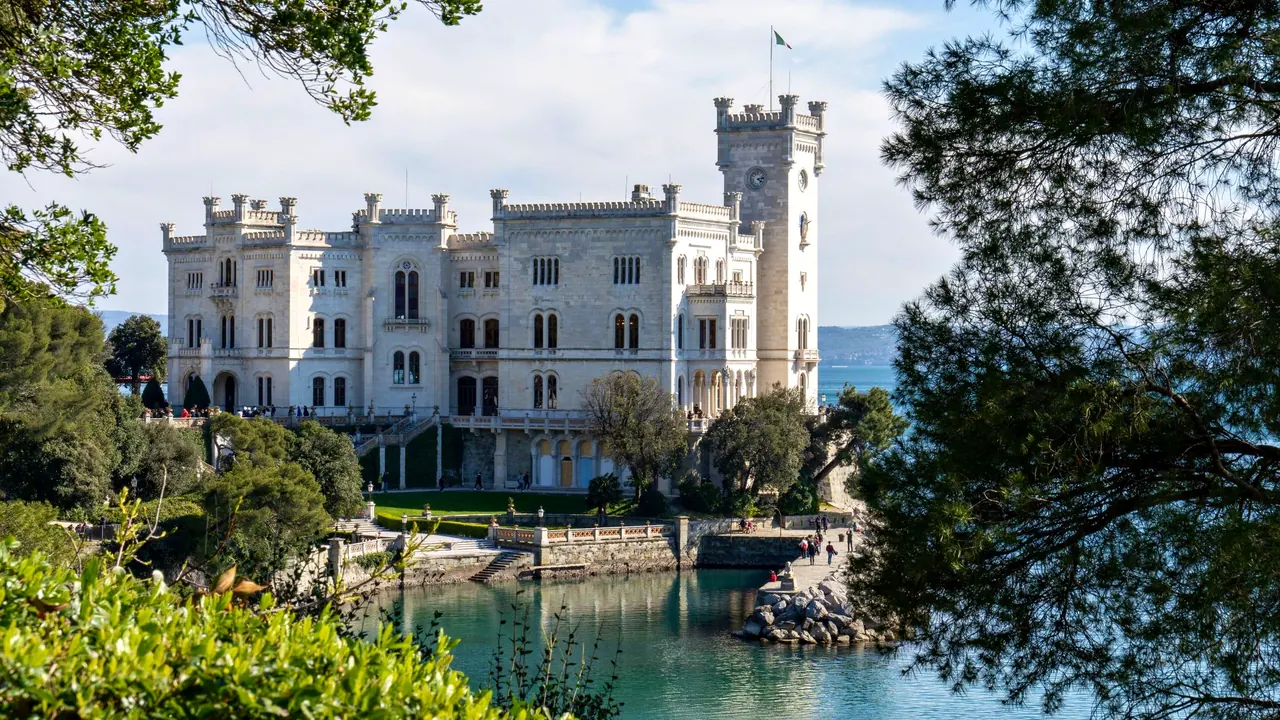
Miramare Castle on the Adriatic, framed by trees
- Day trips80
- Nature & outdoors70
- Getting around70
Photo: Tibor Szabo, Pexels License
Match
57
Every category weighted equally
- Beach & sun57
- Culture & arts59
- Food & nightlife55
- Family trip61
- Outdoors63
- Relax & unwind58
- Shopping & style55
- On a budget57
Trieste in twelve categories
Our verdict on each, scored 0 to 100 against the same fixed benchmark cities, so a score means the same thing on every page.
Beaches & swimming. Scores 64 out of 100.
Food & drink. Scores 63 out of 100.
Culture & sights. Scores 64 out of 100.
Nightlife. Scores 33 out of 100.
Nature & outdoors. Scores 70 out of 100.
Day trips. Scores 80 out of 100.
Good for families. Scores 55 out of 100.
Getting around. Scores 70 out of 100.
Shopping & style. Scores 38 out of 100.
Affordability. Scores 55 out of 100.
Live music & performing arts. Scores 55 out of 100.
Wellness & relaxation. Scores 40 out of 100.
Trieste category by category
Beaches & swimming
64Trieste swims without beaches in the usual sense. The main stretch is Barcola, a long seafront promenade north of the centre where residents lay towels on stepped concrete platforms and pine-shaded lawns and climb down ladders into the Adriatic. In high summer the sea reaches around 24°C and is clear. Closer to town there are old-style bathing establishments with changing cabins, one of them still divided into separate men's and women's sides.
Further along the coast, the small pebble coves below the cliffs at Sistiana and Duino and the bay at Grignano near Miramare are prettier. The Slovenian shore around Piran is under an hour away. Sand is close to absent, so families after soft beaches and shallow water will be let down. Anyone who is happy to swim off rocks will find the sea easy to use, and it is part of daily life from June to September.
Food & drink
63Trieste eats like a city at the meeting point of Italy, Austria and the Slavic world. The local institution is the buffet, an old-fashioned bar counter where boiled pork, sausages and cured ham are carved from steaming pots and served with mustard, horseradish and sauerkraut. Jota, a bean and sauerkraut soup, sits on menus next to Adriatic fish, sardoni fried or marinated, and Central European cakes such as presnitz and strudel.
Coffee is the other pillar. This was the Habsburg empire's coffee port, and it has a vocabulary all its own: a 'nero' is an espresso and a 'capo in b' a small macchiato served in a glass. You drink it in grand old coffee houses or at standing bars. Up on the Karst plateau, farmhouse osmize open for a few weeks at a time to sell their own wine, cheese and cured meats. They are the places to try Vitovska and Terrano. The range of restaurants is narrow, though, and fine dining is limited.
Culture & sights
64Trieste is the Habsburg empire's old seaport, and the centre still looks the part. Piazza Unità d'Italia, one of Europe's largest squares facing the sea, is framed by grand palaces of government and insurance. Behind it, the grid of the Borgo Teresiano runs along the Canal Grande, with neoclassical blocks and the domed Serbian Orthodox church of San Spiridione. Above the old town, San Giusto hill has a cathedral built from two older churches, with Byzantine-style mosaics, and a castle with views over the gulf. Lower down is a Roman theatre.
On the coast, the white Miramare Castle, built for Archduke Maximilian, is the best-known sight. In town there are the Revoltella art museum and one of Europe's largest synagogues. The Risiera di San Sabba, a former Nazi camp, is a sobering memorial. The city's literary past, from Joyce to Svevo and Saba, adds atmosphere more than sights.
Nightlife
33Evenings in Trieste centre on the aperitivo. People drink spritz and local white wine at tables around Piazza Unità, along the Canal Grande and in the lanes of Cavana and the old town. Students from the university keep a few streets busy with wine bars and pubs. In summer the crowd moves out to the Barcola seafront, where kiosks and bars stay open into warm nights.
That is about the extent of it. The city's population is on the older side, there are few clubs, and on a winter weeknight the streets are quiet by midnight. It suits a long dinner and a drink by the sea, not a big night out.
Nature & outdoors
70Trieste is squeezed onto a narrow strip between the sea and the Karst, a limestone plateau that rises steeply behind the city. That makes the outdoors very close. The Strada Napoleonica is an easy walk along the plateau's edge, high above the gulf. The Rilke Path follows the cliffs near Duino Castle. Val Rosandra, a gorge with a river, is good for hiking and climbing on the city's southern edge. The Karst also hides caves, including the huge Grotta Gigante and, just over the border in Slovenia, the Škocjan Caves.
The gulf is a serious sailing water, and the city's autumn regatta, the Barcolana, fills the bay with sails. The Miramare coast is a marine reserve for snorkelling and kayaking. The Bora, a cold north-easterly that can blow at storm force in winter, is part of the character. The Julian Alps are within reach for longer days in the mountains.
Day trips
80Trieste is a good base for day trips, and three countries' worth of places lie within reach. In Friuli, Roman and early Christian Aquileia with its huge mosaic floor is about an hour away. So are the Lombard town of Cividale del Friuli and Palmanova, a fortress town laid out as a perfect star. Grado's lagoon old town, Udine's Venetian squares and the border town of Gorizia are easy too, as is the Collio wine country of white wines and hilltop villages.
Across the Slovenian border, Venetian-style Piran sits on its peninsula under an hour away. Ljubljana, the Lipica stud farm and the Postojna cave are a little further. The Istrian towns of Croatia, such as Rovinj, are possible by car. Venice is about two hours by train, which makes for a long but realistic day out.
Good for families
55Trieste is a safe, calm, manageable city to bring children to, but not much in it is built for them. The best outings are the gardens and seafront around Miramare Castle and the Grotta Gigante, a cave so large that older children are usually amazed. In town there are a small marine aquarium on the waterfront and a hands-on science centre, and summer days on the Barcola promenade are popular with local families.
The downsides are practical. Swimming is off rocks and concrete steps rather than sandy shallows, much of the city above the waterfront is steep and stepped, and the Bora can make winter days unpleasant. Older children who enjoy castles, caves and boats will like it more than toddlers.
Getting around
70Central Trieste is easy on foot. Piazza Unità, the Canal Grande, the Borgo Teresiano, the waterfront and the museums are all close together on flat ground by the sea. The catch is height. San Giusto and the residential districts behind it climb steeply, with long flights of steps, so the walk up to the cathedral and castle is real exercise.
There is no metro, but a dense city bus network covers the rest. Buses run along the coast road to Barcola and Miramare and up onto the Karst, and passenger boats cross the bay to Muggia and run along the coast. A car is useful only for the Karst villages, wine country and trips across the border.
Shopping & style
38Shopping in Trieste is low-key. The streets around Corso Italia and the Borgo Teresiano have the usual Italian clothing and shoe shops, with no real luxury or flagship scene. The most characterful browsing is in the antique and second-hand shops in the lanes of the old town, a reminder of the city's merchant past. The things worth taking home are edible: coffee from the city's roasters, Karst wines and honey, and pastries such as presnitz. A street market by the Canal Grande sells clothes and household goods. Nobody comes here to shop.
Affordability
55Trieste is moderately priced for northern Italy and noticeably easier on the budget than the famous Italian cities. A coffee at the bar and a plate of boiled meats at a buffet cost little. Rooms are reasonable for most of the year, though they tighten around the autumn regatta and in high summer, and buses are cheap. Some of the best experiences cost nothing: the waterfront, the cathedral hill, swimming at Barcola and walks on the Karst. Seafood restaurants and smarter hotels charge ordinary Italian city prices, so it is fairly priced rather than cheap.
Live music & performing arts
55Trieste takes its opera seriously. The Teatro Verdi, an elegant 19th-century house on the waterfront, presents a proper season of opera and ballet, and the city has a long attachment to operetta, a Habsburg legacy that is rare in Italy. The Politeama Rossetti stages prose theatre and touring musicals, and a Slovenian-language theatre reflects the city's mixed population. Summer brings open-air concerts and performances, some in the castle courtyard on San Giusto.
Outside the theatres there is less. A few bars host jazz and local bands, but the live-music circuit is small, and anyone who wants a performance most nights of the week will run out of options.
Wellness & relaxation
40Trieste has no bathing tradition beyond the sea, and its spa offer is limited to hotel spas and a few day spas. What it does have is pace. This is an unhurried city with an older population, long sittings in old coffee houses over a newspaper, and evening strolls along the Molo Audace pier as the sun sets over the gulf. It suits travellers who want quiet days and literary atmosphere. For proper thermal baths, a visitor has to leave the city.
When should you go?
Pick a month to see what it is like. The climate figures are measured averages, not a forecast.
Trieste in July
Daytime high, °C
Rainfall in the month, mm
The whole year
Shaded against this city’s own year: the deepest cell is its best month for that figure and the palest its weakest.
Temperature and rainfall are climate normals, averaged over the years shown. Trieste: 1991-2020 normals, Trieste (1.6 km from centre).
Before you go
| Measure | Trieste |
|---|---|
| Official language | Italian |
| Currency | Euro (EUR) |
| Sockets | CFL230 V, 50 Hz |
| Driving side | Right |
| Time zone | UTC+1, UTC+2 in summer |
| Emergency number | 112 |
| Elevation | 2 m |
| Main airport | Trieste Airport (TRS)31 km from centre32 non-stop destinations |
| Public holidays this year | 13 days |
By the numbers
| Measure | Trieste |
|---|---|
| City population | 198,417 |
| People per km² | 2,332 |
| Museums within 10 km | 33 |
| UNESCO World Heritage sites within 50 km | 5 |
| Swim season, months above 21 °C | 4 months |
Compare Trieste with
Every comparison with a written verdict behind it.
- Amalfi
- Bari
- Bled
- Bologna
- Bratislava
- Budapest
- Catania
- Como
- Cortina d'Ampezzo
- Dubrovnik
- Florence
- Genoa
- Graz
- Hallstatt
- Innsbruck
- Interlaken
- La Spezia
- Lecce
- Ljubljana
- Lucca
- Lucerne
- Matera
- Milan
- Mostar
- Munich
- Naples
- Nuremberg
- Palermo
- Pisa
- Portofino
- Positano
- Prague
- Rome
- Rovinj
- Salerno
- Salzburg
- Sarajevo
- Siena
- Sorrento
- Split
- Stuttgart
- Turin
- Venice
- Verona
- Vienna
- Zadar
- Zagreb
- Zurich