Italy
Venice
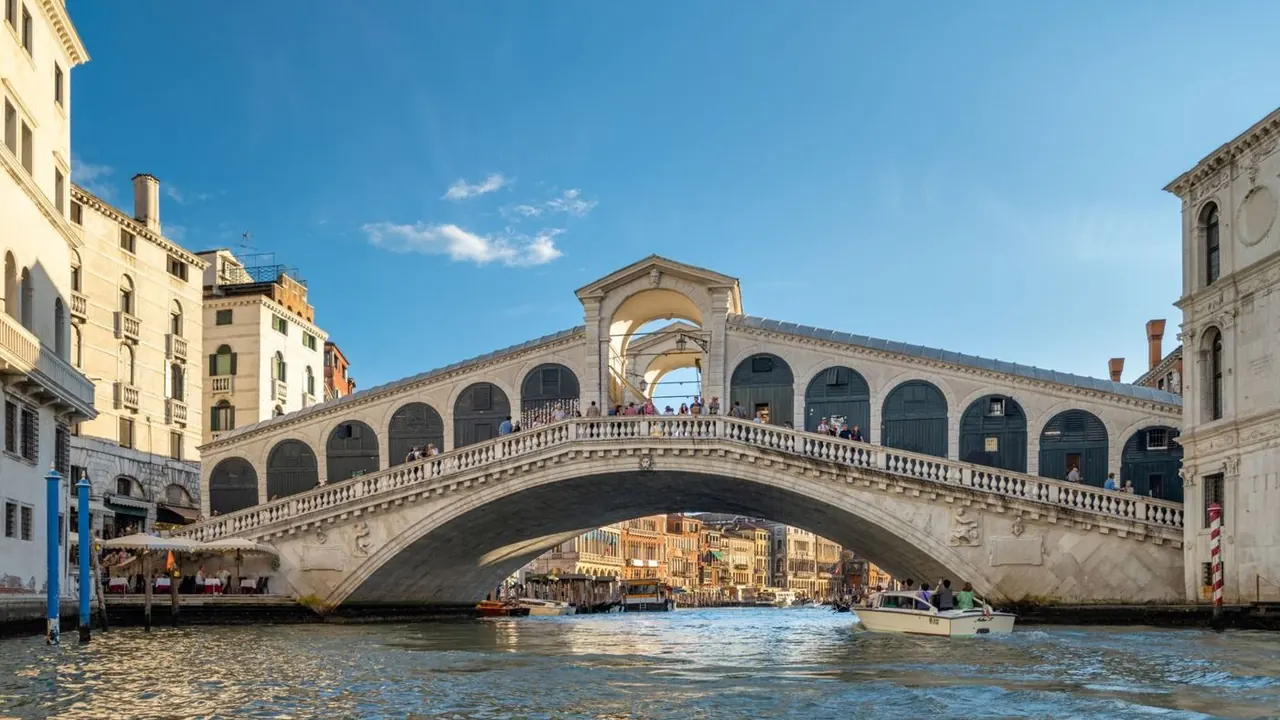
The Rialto Bridge on the Grand Canal
- Culture & sights94
- Day trips86
- Getting around68
Photo: David Vives, Pexels License
Match
55
Every category weighted equally
- Beach & sun51
- Culture & arts63
- Food & nightlife55
- Family trip55
- Outdoors56
- Relax & unwind54
- Shopping & style57
- On a budget51
Venice in twelve categories
Our verdict on each, scored 0 to 100 against the same fixed benchmark cities, so a score means the same thing on every page.
Beaches & swimming. Scores 56 out of 100.
Food & drink. Scores 60 out of 100.
Culture & sights. Scores 94 out of 100.
Nightlife. Scores 27 out of 100.
Nature & outdoors. Scores 45 out of 100.
Day trips. Scores 86 out of 100.
Good for families. Scores 45 out of 100.
Getting around. Scores 68 out of 100.
Shopping & style. Scores 57 out of 100.
Affordability. Scores 20 out of 100.
Live music & performing arts. Scores 62 out of 100.
Wellness & relaxation. Scores 40 out of 100.
Venice category by category
Beaches & swimming
56Venice has a real beach on its doorstep. The Lido, the long barrier island that closes off the lagoon, is a short vaporetto ride from San Marco and has kilometres of fine sand facing the open Adriatic. Much of it is set out in rows of private cabanas and changing huts, with free public stretches at the ends. The water is shallow, gentle and warm in high summer, around 25°C, which suits children and waders, though it is greenish rather than clear.
Further along, Pellestrina is quieter and wilder, and the big resort strips of Jesolo and Sottomarina are within about an hour. Still, almost nobody comes to Venice for the sea. Most visitors spend one hot afternoon at the Lido at most, and the canals themselves are not for swimming.
Food & drink
60The best way to eat in Venice is standing up. Bacari, the old wine bars around the Rialto and in Cannaregio and Castello, lay out cicchetti on the counter: creamed salt cod on bread, sarde in saor with sweet onions, fried soft-shell crab in season, tiny meatballs, all taken with a small glass of wine or a spritz in the late morning or early evening. The Rialto fish and produce market supplies the lagoon cooking, with cuttlefish risotto blackened by its ink, bigoli in salsa, and moeche and canocchie from the lagoon.
The catch is the sheer number of indifferent restaurants with picture menus around San Marco and the main routes. Good meals exist but need seeking out in quieter sestieri, and the city is weak on anything beyond Venetian and Italian cooking.
Culture & sights
94Venice is a city where the setting itself is the main sight: some six hundred years of palaces, churches and bridges standing on water, with no cars and almost nothing modern to break the view. Piazza San Marco gathers the headline landmarks, the gold-mosaic Basilica of San Marco, the Doge's Palace with its prisons and Bridge of Sighs, and the Campanile. The Grand Canal, lined with Gothic and Renaissance palazzi, is best seen slowly from the water.
The art goes very deep. The Gallerie dell'Accademia holds the great Venetian painters, Titian hangs in the Frari, Tintoretto fills the Scuola Grande di San Rocco, and the Peggy Guggenheim Collection and Punta della Dogana cover modern art. Smaller churches all over town hold masterpieces, and the Biennale fills the Arsenale and Giardini in alternating art and architecture years. A week barely covers it.
Nightlife
27Venice goes to bed early. The liveliest hour is the aperitivo, when locals and visitors crowd the bacari around the Rialto and along the Fondamenta della Misericordia in Cannaregio with spritzes in hand. Campo Santa Margherita in Dorsoduro, close to the university, keeps a few bars busy later with students spilling into the square. After that there is little: no club district, a handful of late bars, and a city whose canals turn dark and silent around midnight. That silence is lovely for a late walk, but anyone who wants a big night out heads to the mainland or to the beach clubs of Jesolo in summer.
Nature & outdoors
45The outdoors here means the lagoon. Its salt marshes, mudflats and fishing valleys, best seen around Torcello, Sant'Erasmo and the northern lagoon, hold herons, egrets and flamingos, and can be explored by kayak or on a lesson in Venetian rowing standing up. Cycling is possible along the Lido and Pellestrina, where the sea walls run for kilometres. Beyond that the terrain is flat: the Euganean Hills near Padua and the Prosecco hills give gentle walking within about an hour, but the Dolomites need more than two hours each way. Green space in the city itself is limited to the Giardini and a few small parks.
Day trips
86Venice sits at the edge of one of Italy's richest regions, and fast trains from Santa Lucia make it easy to use. Padua is about half an hour away, with Giotto's Scrovegni Chapel and an old university. Verona, with its Roman arena and medieval centre, is about an hour and a quarter, and Vicenza, Palladio's city, lies between the two. Treviso, Bassano del Grappa and the Palladian villas along the Brenta Canal are close, and the Prosecco hills around Valdobbiadene make a good wine day by car. Bologna and Trieste are about two hours.
The lagoon adds its own day out without any train: Murano for glass furnaces, Burano for its brightly painted houses and lace, and Torcello for a Byzantine cathedral standing almost alone among the marshes.
Good for families
45Children tend to love the idea of Venice: boats instead of buses, no cars to watch out for, and a maze of alleys to get lost in. A ride along the Grand Canal on a vaporetto, a glass-blowing demonstration on Murano and an afternoon on the shallow, sandy Lido beach all go down well, and the natural history museum has dinosaurs. The hard part is practical. Hundreds of stepped bridges make pushchairs a constant struggle, the main routes are packed in summer, it can be hot and humid, and there are few playgrounds, parks or attractions made for children. Short stays with older children work best.
Getting around
68Venice is a walking city by necessity. There are no cars or bikes, and almost everything a visitor wants lies within a forty-minute walk across the centre, though the alleys twist, dead-end at canals and routinely get people lost. The vaporetto water buses run along the Grand Canal and out to the Lido, Murano and Burano, and the traghetto gondolas cross the Grand Canal at points between the bridges.
The drawbacks are physical. Hundreds of bridges have steps, which makes wheeled luggage, pushchairs and wheelchairs hard work, and the main vaporetto lines are slow and crowded. Water taxis help but are expensive. Arriving is easy, with trains ending at Santa Lucia and buses at Piazzale Roma, and the airport is linked by bus and boat.
Shopping & style
57Shopping in Venice is about crafts with long histories. Murano glass, from heavy chandeliers to small beads, Burano lace, handmade carnival masks of papier-mâché, marbled paper and bookbinding, and velvet slippers called furlane are all made here, and the real workshops are worth finding in Dorsoduro, Castello and on Murano itself. The big Italian and international fashion names line Calle Larga XXII Marzo and the Mercerie between San Marco and the Rialto.
The main routes, though, are crowded with cheap imported glass and masks sold as local, so it pays to look for workshops where the craft is visibly done on site. There are no large department stores or broad fashion districts, and mainstream shopping is on the mainland at Mestre.
Affordability
20Venice is one of the most expensive places to stay in Italy. Hotel rooms in the historic centre cost far more than in most European cities, especially around San Marco and in summer and carnival, and table service in a café on the main piazza is famously steep. Water transport is priced for visitors rather than residents, and the main sights and churches mostly charge for entry. Costs come down by eating cicchetti standing at a bar counter, staying in quieter sestieri or on the mainland at Mestre, and visiting in late autumn or winter outside the festival periods.
Live music & performing arts
62The heart of the scene is La Fenice, one of Italy's great opera houses, which has premiered works by Verdi and Rossini and runs a full season of opera, ballet and symphonic concerts, with the smaller Teatro Malibran sharing the programme. The Teatro Goldoni stages Italian-language drama, and the Biennale runs its own festivals of contemporary music, theatre and dance.
Most evenings visitors also meet the city's other tradition: baroque concerts of Vivaldi and his contemporaries in churches and scuole grandi, often by period-costumed ensembles. Some are excellent, many are routine, but hearing Vivaldi in the city where he worked has its own pull. Jazz clubs, rock venues and independent music are sparse.
Wellness & relaxation
40Venice has no bathing tradition of its own, and spa options in the city are hotel spas, several in grand palazzi and on the Lido and Giudecca. The nearest real thermal culture is in the Euganean towns of Abano Terme and Montegrotto Terme near Padua, about an hour away, where hot mud and thermal pools have been used since Roman times.
The city's restorative quality is in its quiet. With no traffic, early mornings and late evenings are hushed, and the outer sestieri of Castello and Cannaregio or the island of Giudecca have a slow, residential rhythm. The daytime crowds around San Marco and the Rialto are the opposite, so a calm stay depends on where and when you walk.
When should you go?
Pick a month to see what it is like. The climate figures are measured averages, not a forecast.
Venice in July
Daytime high, °C
Rainfall in the month, mm
The whole year
Shaded against this city’s own year: the deepest cell is its best month for that figure and the palest its weakest.
Where the figures come from
Venice has no rain gauge within 25 km of the centre, so its rainfall comes from a gridded climate dataset read at the city rather than from a gauge further away.
Venice's sunshine is measured 26 km from the centre, at Treviso / S. Angelo.
Temperature and rainfall are climate normals, averaged over the years shown. Venice: 1991-2020 normals, Venezia / Tessera (6.7 km from centre).
Before you go
| Measure | Venice |
|---|---|
| Official language | Italian |
| Currency | Euro (EUR) |
| Sockets | CFL230 V, 50 Hz |
| Driving side | Right |
| Time zone | UTC+1, UTC+2 in summer |
| Emergency number | 112 |
| Elevation | 2 m |
| Main airport | Venice Marco Polo Airport (VCE)7 km from centre103 non-stop destinations |
| Public holidays this year | 13 days |
By the numbers
| Measure | Venice |
|---|---|
| City population | 250,369 |
| People per km² | 602 |
| Museums within 10 km | 52 |
| UNESCO World Heritage sites within 50 km | 5 |
| Swim season, months above 21 °C | 4 months |
Compare Venice with
Every comparison with a written verdict behind it.
- Amalfi
- Amsterdam
- Annecy
- Antibes
- Baden-Baden
- Bled
- Bologna
- Bratislava
- Cannes
- Catania
- Como
- Florence
- Geneva
- Genoa
- Innsbruck
- Interlaken
- La Spezia
- Ljubljana
- Lucerne
- Milan
- Monaco
- Mostar
- Munich
- Naples
- Nice
- Nuremberg
- Palermo
- Paris
- Pisa
- Portofino
- Positano
- Rome
- Rovinj
- Salzburg
- Siena
- Sorrento
- Split
- Strasbourg
- Stuttgart
- Turin
- Verona
- Vienna
- Zadar
- Zagreb
- Zurich