Italy
Padua
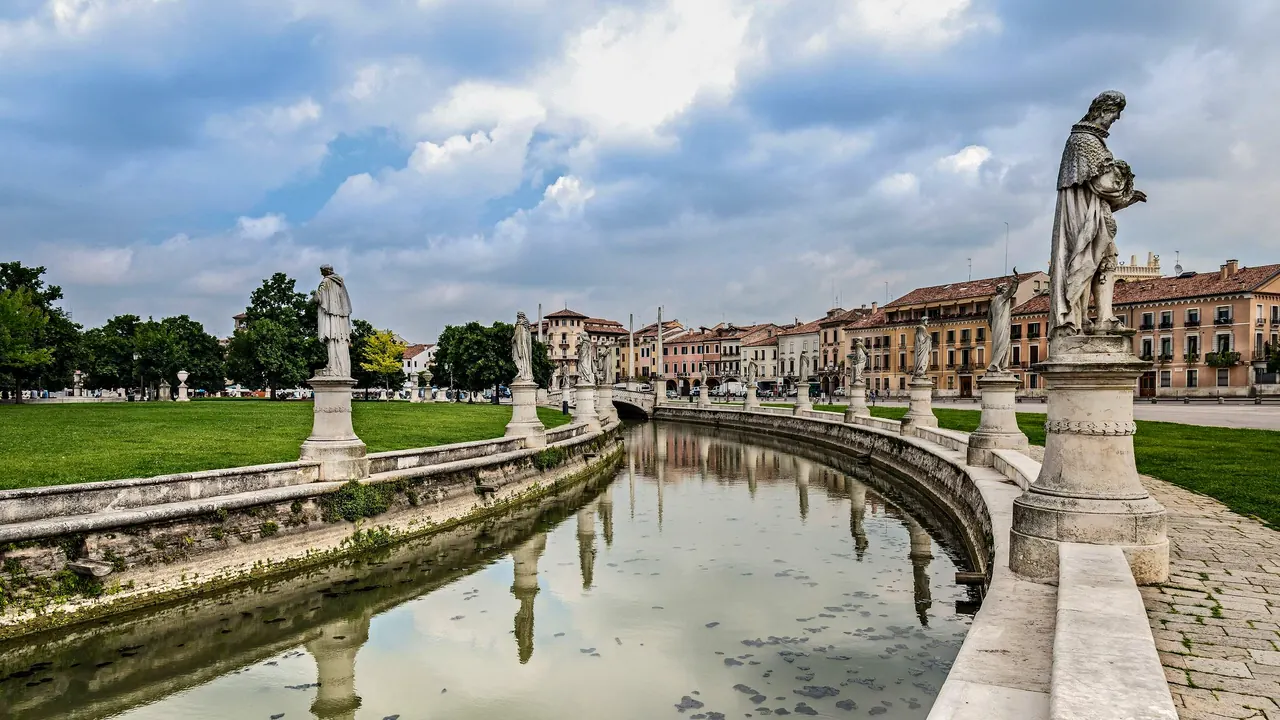
The canal and statues of the Prato della Valle
- Day trips94
- Getting around76
- Culture & sights74
Photo: Didier Descouens, CC BY-SA 4.0, cropped
Match
57
Every category weighted equally
- Beach & sun55
- Culture & arts62
- Food & nightlife57
- Family trip57
- Outdoors61
- Relax & unwind58
- Shopping & style57
- On a budget57
Padua in twelve categories
Our verdict on each, scored 0 to 100 against the same fixed benchmark cities, so a score means the same thing on every page.
Beaches & swimming. Scores 30 out of 100.
Food & drink. Scores 62 out of 100.
Culture & sights. Scores 74 out of 100.
Nightlife. Scores 45 out of 100.
Nature & outdoors. Scores 55 out of 100.
Day trips. Scores 94 out of 100.
Good for families. Scores 42 out of 100.
Getting around. Scores 76 out of 100.
Shopping & style. Scores 45 out of 100.
Affordability. Scores 54 out of 100.
Live music & performing arts. Scores 38 out of 100.
Wellness & relaxation. Scores 68 out of 100.
Padua category by category
Beaches & swimming
30Padua is an inland city on the Venetian plain, and the sea is a side trip rather than part of a stay. The nearest sand is at Sottomarina, beside Chioggia, and on the Lido of Venice, each about an hour away by car or by train and boat. The Adriatic here warms to around 25°C in high summer and is shallow and calm, which suits paddling children, but the beaches are long, flat strips of umbrellas and bathing establishments rather than anything scenic. Visitors who want a day at the sea can manage it easily enough, but nobody chooses Padua for swimming.
Food & drink
62Eating in Padua is rooted in Venetian home cooking: bigoli pasta with duck or sardine sauce, baccalà alla vicentina, risotto with spring peas, boiled meats with green sauce and the local hen of the Padovana breed. The heart of it is the twin markets in Piazza delle Erbe and Piazza della Frutta, where fruit, vegetable and cheese stalls trade every morning and the arcaded shops beneath the Palazzo della Ragione sell cured meats, fresh pasta and fish.
The drinking culture matters as much as the food. The spritz is a ritual here, taken standing in the squares in the early evening with small bites, and the Euganean Hills supply reds and the sweet Fior d'Arancio from just outside town. Caffè Pedrocchi, the grand nineteenth-century coffee house, is an institution in its own right. Fine dining is limited and the international range is narrow.
Culture & sights
74Padua's headline is the Scrovegni Chapel, whose walls Giotto covered with a cycle of frescoes in the early fourteenth century that changed European painting; visits are short, timed and worth planning around. Around it, the city's fourteenth-century fresco cycles in the Eremitani church, the Baptistery and the Oratory of Saint George form a UNESCO-listed group. The Basilica of Saint Anthony, with its Byzantine domes and Donatello's bronze altar and equestrian Gattamelata outside, is one of Italy's great pilgrimage churches.
The medieval Palazzo della Ragione holds a vast frescoed hall above the markets, and the university's Palazzo Bo keeps the oldest permanent anatomical theatre in the world. The Orto Botanico, founded in 1545, is the oldest university botanical garden still in its original place. Prato della Valle, an oval square ringed with statues, completes a centre that is rich but quickly covered.
Nightlife
45Going out in Padua means the aperitivo. From early evening the squares around the Palazzo della Ragione fill with students and locals standing over spritz glasses, and on warm nights the crowd spills across Piazza delle Erbe and Piazza dei Signori until late. The university keeps the old centre lively on weekday evenings during term, with wine bars and small pubs in the side streets of the old ghetto and around the Bo. Clubs are few and mostly on the edge of town, and in high summer and the university breaks the city goes quiet. It is a pleasant, sociable evening rather than a big night out.
Nature & outdoors
55The city sits on the flat Venetian plain, so the outdoors starts a little way out. The Euganean Hills, a cluster of old volcanic cones about 15km to the south-west, rise abruptly from the fields and are a regional park with marked trails, vineyards, chestnut woods and quiet roads popular with road cyclists. Closer in, towpaths along the Brenta and the old canals make easy, level bike rides through villa country.
The lagoon to the east suits birdwatching and rowing, and the plateaus and foothills of the pre-Alps, such as Monte Grappa and the Asiago plateau, are within about one and a half hours by car for proper mountain walking. Summers are hot and humid, and winter fog often sits low over the plain.
Day trips
94Few cities make a better base. Venice is under half an hour away by train, close enough to visit on several days and return to a calmer, cheaper bed each night. Vicenza, with Palladio's Teatro Olimpico and palaces, is a quarter of an hour by train, and Verona, Treviso and Bassano del Grappa are each around an hour or less. Bologna and Ferrara lie about an hour south on fast trains.
Closer still are the villas of the Brenta Riviera, reachable by road or by boat along the canal towards Venice, and the small towns around the Euganean Hills: Arquà Petrarca, where the poet spent his last years, and the walled towns of Este, Monselice and Montagnana. Chioggia's fishing port, Asolo and the Prosecco hills round out a long, varied list.
Good for families
42Padua is easy with children in a practical sense: the centre is flat, compact and safe, much of it pedestrianised, and Italian family life makes children welcome in any trattoria. Prato della Valle is a good place to let them run, and the botanical garden and its glasshouses interest older children. Beyond that there is little made for them, and the main sights are frescoes and churches. Families usually fill the gaps with day trips: Gardaland and the lake beaches of Garda are about an hour and a quarter away, and the Adriatic is about an hour.
Getting around
76The historic centre is small and flat, and almost everything a visitor wants, from the Scrovegni Chapel to the Basilica of Saint Anthony, is within a 20-minute walk. Arcaded streets shelter pedestrians from rain and sun, and much of the core is closed to general traffic. A tram links the railway station with the centre and Prato della Valle, buses fill in the rest, and bicycles are a normal way to get about.
The station is the real asset: Padua sits on main lines in every direction, so trains to Venice, Vicenza, Verona and Bologna are quick enough to plan day trips without a car. A car is only useful for the hills and the villa countryside.
Shopping & style
45Shopping in Padua is pleasant rather than a reason to come. The arcaded streets between the station and the old squares carry Italian fashion and shoe shops, a few good independent boutiques and bookshops serving the university. The daily markets in Piazza delle Erbe and Piazza della Frutta, and the delicatessens under the Palazzo della Ragione, are the best place to buy food to take home, from cheeses to Euganean wine. A large antiques and bric-a-brac market fills Prato della Valle one Sunday a month. Serious fashion shoppers head to Venice or Milan.
Affordability
54Padua costs about what a northern Italian city of its size usually does, which is moderate by Western European standards. Its hotels are a reasonably priced base for the whole region, which is why many visitors sleep here and spend their days elsewhere by train. A standing spritz and a plate of market produce are inexpensive, trattoria meals are fairly priced, and the centre is walkable, so transport costs little. The Scrovegni Chapel and the main museums charge normal entry fees, and rooms get dearer around the big trade fairs and graduation season.
Live music & performing arts
38Padua has a modest but genuine year-round programme. Teatro Verdi, a nineteenth-century horseshoe theatre, hosts prose theatre and some opera, and the city's chamber orchestra gives a regular concert season, with chamber music in the frescoed Sala dei Giganti and in the Basilica of Saint Anthony. Students sustain small live-music venues and summer open-air concerts. For major opera visitors go to the Fenice in Venice or the summer Arena in Verona, both within easy reach.
Wellness & relaxation
68Padua's great wellness asset lies just outside town. Abano Terme and Montegrotto Terme, at the foot of the Euganean Hills about 12km away, form one of Europe's largest thermal districts, where hot, mineral-rich water rises at up to 87°C and the local mud has been used for treatments since Roman times. Dozens of spa hotels have indoor and outdoor thermal pools, and many accept day visitors, so a soak after a morning of sightseeing is easy by bus, train or a short taxi ride.
The city itself has an unhurried provincial rhythm: long lunches, arcades to stroll under and quiet hours in the botanical garden or along the canals. Hot, humid summers make spring and autumn the gentler seasons for a restful stay.
When should you go?
Pick a month to see what it is like. The climate figures are measured averages, not a forecast.
Padua in July
Daytime high, °C
Rainfall in the month, mm
The whole year
Shaded against this city’s own year: the deepest cell is its best month for that figure and the palest its weakest.
Where the figures come from
Padua's temperatures are measured 35 km from the centre, at Treviso / Istrana.
Padua has no rain gauge within 25 km of the centre, so its rainfall comes from a gridded climate dataset read at the city rather than from a gauge further away.
Padua's sunshine is measured 36 km from the centre, at Treviso / S. Angelo.
Temperature and rainfall are climate normals, averaged over the years shown. Padua: 1991-2020 normals, Treviso / Istrana (35.4 km from centre).
Before you go
| Measure | Padua |
|---|---|
| Official language | Italian |
| Currency | Euro (EUR) |
| Sockets | CFL230 V, 50 Hz |
| Driving side | Right |
| Time zone | UTC+1, UTC+2 in summer |
| Emergency number | 112 |
| Elevation | 12 m |
| Main airport | Venice Marco Polo Airport (VCE)39 km from centre103 non-stop destinations |
| Public holidays this year | 13 days |
By the numbers
| Measure | Padua |
|---|---|
| City population | 206,496 |
| People per km² | 2,220 |
| Museums within 10 km | 29 |
| UNESCO World Heritage sites within 50 km | 5 |
| Swim season, months above 21 °C | 4 months |
Compare Padua with
Every comparison with a written verdict behind it.
- Amalfi
- Annecy
- Antibes
- Baden-Baden
- Bari
- Basel
- Bergamo
- Bern
- Bled
- Bologna
- Cannes
- Catania
- Cesky Krumlov
- Chamonix
- Colmar
- Como
- Cortina d'Ampezzo
- Florence
- Freiburg
- Geneva
- Genoa
- Graz
- Hallstatt
- Innsbruck
- Interlaken
- La Spezia
- Lausanne
- Lecce
- Ljubljana
- Lucca
- Lucerne
- Lugano
- Matera
- Milan
- Monaco
- Munich
- Naples
- Nice
- Nuremberg
- Palermo
- Piran
- Pisa
- Portofino
- Positano
- Pula
- Rome
- Rovinj
- Saint-Tropez
- Salerno
- Salzburg
- Siena
- Sorrento
- Split
- Strasbourg
- Stuttgart
- Syracuse, Sicily
- Taormina
- Trieste
- Turin
- Venice
- Verona
- Vienna
- Zadar
- Zagreb
- Zermatt
- Zurich